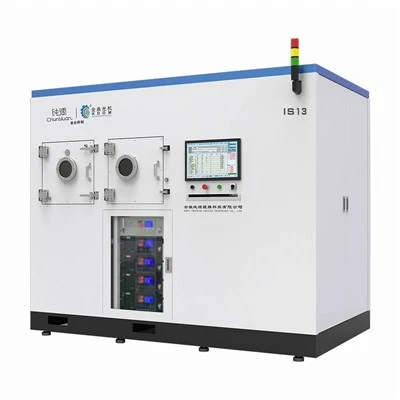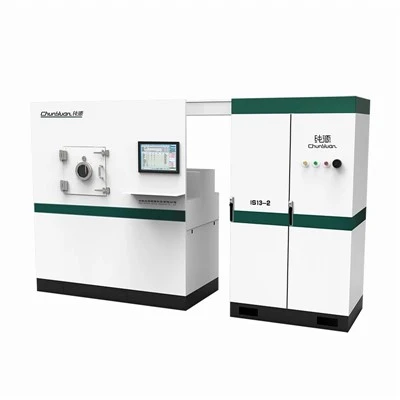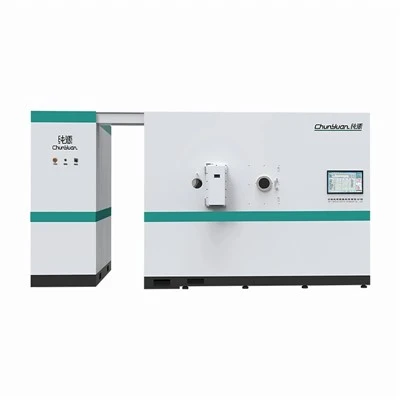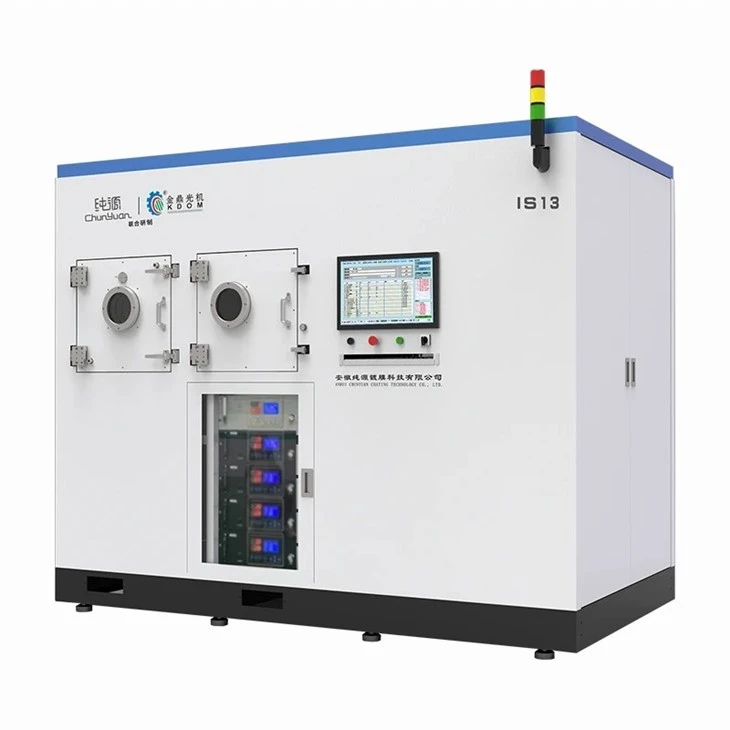
The PVD Composite Thin Film Equipment is an industrial vacuum platform designed to synthesize multi-layer, alloy, and graded thin films. Built on a modular 304L/316L stainless steel architecture, it integrates up to four independent deposition sources-including DC/RF magnetron sputtering, electron beam evaporation, and thermal sources-into a single contamination-controlled chamber. The system provides precise control over film microstructure, residual stress, and compositional gradients for production lines and advanced R&D.
Technical Specifications
|
Parameter |
Specification |
Standard / Condition |
|
Ultimate Base Pressure |
<= 5.0 x 10^-6 Pa |
Cryo/Turbo backed |
|
Working Pressure |
0.1 to 5.0 Pa |
Process dependent |
|
Substrate Capacity |
φ300 mm wafers or 400 x 400 mm substrates |
Custom pallets available |
|
Thickness Uniformity |
<= ±2% |
Measured across full substrate area |
|
Substrate Temperature |
Room Temp to 800°C |
Closed-loop PID controlled |
|
Deposition Ports |
4 independent modular slots |
Sputter / E-beam configurable |
|
Chamber Construction |
304L / 316L Stainless Steel |
Electro-polished, Ra <= 0.2 μm |
|
Power Distribution |
DC, RF (13.56 MHz), Pulsed DC, Bias |
PLC safety interlocked |
Key Features
Modular Multi-Source Architecture: Executes sequential or co-deposition from up to four sources in a single vacuum cycle.
Ultra-Clean Vacuum Integrity: Employs metal-sealed CF flanges, pneumatic gate valves, and oil-free roughing/turbomolecular pumping to prevent hydrocarbon contamination.
Dynamic Substrate Biasing: Variable frequency RF/DC biasing controls incoming ion energy to govern film density, hardness, and stress.
Automated Recipe Control: Industrial PLC and HMI store up to 200 process profiles, automating pump-down, shutter actuation, and venting.
In-Situ Monitoring Ports: Pre-configured flanges accommodate QCM thickness sensors and optical emission spectrometers (OES).
Vacuum & Gas Subsystems
Pumping Stack: Oil-free roots/screw roughing pumps paired with magnetically levitated turbopumps or cryopumps reach 5 x 10^-6 Pa from atmosphere within 45 minutes.
Gas Delivery: Mass Flow Controllers (MFCs) regulate Ar, O2, and N2 with ±1% Full Scale accuracy; integrated purifiers maintain 99.9999% gas purity.
Thermal Management: Chamber bodies feature double-wall water-cooling channels to stabilize structural dimensions during high-temperature runs.
Materials & Substrate Compatibility
Supported Materials
Metals: Ti, Cr, Al, Cu, Au, Pt, NiCr, TiAl
Dielectrics / Oxides: SiO2, TiO2, Al2O3, Si3N4
Hard Coatings: TiN, TiCN, CrN, DLC interlayers
Substrate Compatibility
Silicon wafers (φ100 mm to φ300 mm).
Fused silica, quartz, and ceramic optical substrates.
Tool steels and titanium alloys requiring pre-clean RF plasma etching.
Applications
Semiconductor: Barrier layers, seed layers, and interconnect metal stacks.
Optics: Optical interference filters, anti-reflective (AR) coatings, and high-reflector mirrors.
Wear Protection: Multi-layer hard coatings for cutting tools and aerospace components.
Energy Storage: Thin films for solid-state battery electrolytes and current collectors.
Customization
Chamber Geometry: Modify internal dimensions or port angles to fit legacy hardware or glovebox docks.
Source Adaptation: Integrate specific e-beam gun ratings, magnetron lengths, or thermal boats.
Software Integration: Configure PLC logic to match facility SCADA protocols or SECS/GEM standards.
Quality Control
Leak Detection: Helium mass spectrometer testing verified down to 1 x 10^-10 Pa·m³/s.
Electrical Safety: Ground continuity, insulation resistance, and E-stop verification per CE/NFPA standards.
Pre-Shipment Run: Factory test deposition verifies base pressure, source stability, and thickness uniformity; data sheets ship with the unit.
Installation & Support
Documentation: Complete electrical schematics, P&ID diagrams, PLC operation manuals, and calibration certificates.
Factory Acceptance (FAT): Client inspection and validation runs at our manufacturing floor prior to crating.
Commissioning (SAT): Field engineers supervise mechanical alignment, utility hookups, and on-site acceptance testing.
FAQ
Q: What is the standard system lead time?
A: 16 to 24 weeks, depending on chamber volume, source quantity, and custom automation requirements.
Q: Can the system switch between RF sputtering and E-beam evaporation without breaking vacuum?
A: Yes. Multi-port architecture allows automated sequential deposition across distinct sources under continuous vacuum.
Q: What utility connections are required on-site?
A: 3-phase AC power, closed-loop chilled water (18°C to 22°C), compressed air (0.6 MPa), and dedicated process gas lines.
Q: How is substrate temperature regulated during processing?
A: Substrate holders use embedded thermocouples or optical pyrometers tied to closed-loop PID heaters and backside gas conduction cooling.
Hot Tags: pvd composite thin film equipment, China pvd composite thin film equipment manufacturers, suppliers, factory