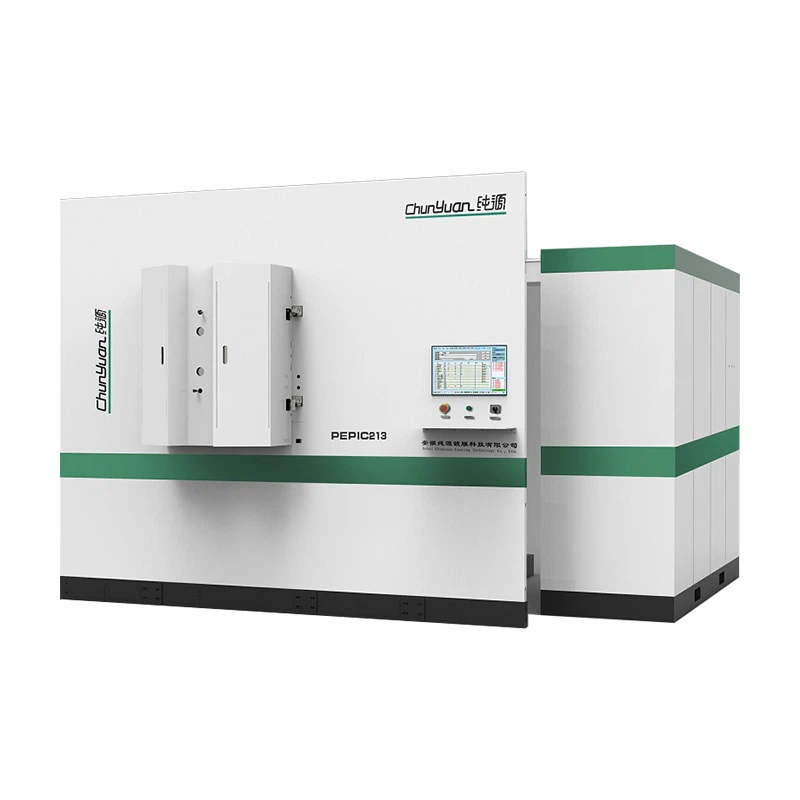
Industrial-grade Ion-Assisted Evaporation (IAE) system integrating multi-pocket electron-beam evaporation with an energetic ion beam source (End-Hall or Kaufman configuration). Real-time ion bombardment transfers kinetic momentum to condensing adatoms, suppressing columnar grain growth and driving thin-film packing density toward bulk material values.
Configured for batch processing on planetary rotation fixtures under dual-PLC automation. Core applications include high-laser-damage-threshold (LIDT) optical interference coatings, dense dielectric filter stacks, and durable protective overcoats.
Technical Specifications & Process Capability
|
Parameter |
Specification & Process Capability |
|
Ultimate Base Pressure |
<= 5.0 x 10^-5 Pa (clean, dry, empty chamber) |
|
Pump-Down Time |
< 15 min from atmosphere to 1.0 x 10^-3 Pa |
|
Chamber Construction |
304L / 316L Stainless Steel; internal electropolishing (Ra <= 0.4 um) |
|
Electron Beam Source |
6 kW / 10 kW multi-pocket sweep gun (4 to 6 crucibles) |
|
Ion Source Type |
End-Hall or Kaufman broad-beam; Energy: 50 - 300 eV; Current: 0 - 1000 mA |
|
Substrate Temperature |
Ambient to 300 deg C (+/- 2 deg C PID closed-loop uniformity control) |
|
Thickness Uniformity |
<= +/- 1.0% across a 400 mm deposition zone (with planetary rotation) |
|
Intrinsic Stress Control |
<= +/- 50 MPa (Compressive/Tensile tunable via ion energy adjustment) |
|
Refractive Index Repeatability |
Delta n <= +/- 0.001 verified over 50 consecutive production runs |
|
System Availability (Uptime) |
>= 95% operational availability under continuous multi-shift production |
|
Control Architecture |
Dual-PLC industrial controller with hardware safety interlocks and recipe management |
Key Features
Energetic Ion Bombardment: Real-time momentum transfer eliminates microvoids, stabilizing refractive indices against moisture-induced spectral shifts.
Reactive Gas Bleeding: Controlled partial pressure injection of O2 or N2 compensates for oxygen deficiency during oxide/nitride deposition, removing sub-oxide absorption bands.
Modular Source Deck: Cassette-style ion source grid replacement and interchangeable E-beam pockets reduce chamber vent-to-vacuum recovery time to under 2 hours.
Vacuum Integrity: Metal-sealed and Viton-sealed ISO/CF flanges paired with pneumatic gate valves prevent cross-contamination across batches.
Vacuum System Configuration
Roughing Package: Roots blower backed by rotary vane or oil-free hermetic scroll mechanical pumps.
High-Vacuum Pump: Cryogenic pump (cryopump) or magnetically levitated turbomolecular pump (air throughput >= 2200 L/s).
Pressure Measurement: Combination Pirani and hot-cathode ionization gauges for continuous logging from atmosphere to high vacuum.
Process Pressure Regulation: Closed-loop capacitance manometer driving an automated butterfly throttle valve during gas injection.
Evaporation Materials & Substrate Compatibility
Evaporation Materials:
Oxides: SiO2, Ta2O5, TiO2, Nb2O5, HfO2
Fluorides: MgF2, LaF3
Metals: Au, Ag, Al, Cr, Ti
Substrate Materials:
Optical Glass (BK7, Fused Silica, Quartz)
Semiconductor Wafers (Silicon, Gallium Arsenide)
Crystals (LiNbO3, Sapphire, YAG)
Fixture Geometry: Custom planetary rotation cages, dome fixtures, and flat-plate holders engineered for specific batch volumes.
Applications & Empirical Performance Evidence
Laser Interference Filters: Narrowband and edge filters requiring extinction ratios with blocking depth > OD6 at 1064 nm.
Anti-Reflective (AR) Coatings: Multi-layer broadband AR coatings for high-power laser windows and camera optics.
Front Surface Mirrors: Low-scatter metal reflectors protected by hard dielectric overcoats for aerospace and defense instrumentation.
Semiconductor Dielectric Layers: Passivating and insulating dielectric film deposition on temperature-sensitive substrates.
Customization
Chamber Sizing: Internal diameters scaled from 700 mm to 1300 mm.
Source Integration: Dual E-beam setups, thermal resistance sources, or co-deposition configurations.
Automation Level: Semi-automatic manual load or fully integrated robotic substrate handling with load-locks.
Compliance: CE, UL/CSA electrical panels, and SEMI S2/S8 safety compliance packages.
Quality Control & Factory Verification
Leak Detection: Mass spectrometer helium leak testing of all chambers and seals to < 1 x 10^-10 Pa*m^3/s.
Dimensional Inspection: CMM verification of internal mounting flanges and optical profilometry confirming chamber wall roughness (Ra <= 0.4 um).
Burn-In Testing: 72-hour continuous dry-run test of vacuum pumps, high-voltage power supplies, and PLC interlock loops.
Process Acceptance Testing (FAT): Reference coating run verifying deposition rate stability and refractive index targets against pre-agreed criteria.
Installation & Technical Support
Pre-Installation Guidance: Layout drawings covering chilled water, exhaust ventilation, electrical loads, and floor weight capacity.
On-Site Commissioning: Field engineering execution of mechanical alignment, leak checks, utility hookups, and joint SAT testing.
Process Training: Operator and maintenance training covering recipe programming, ion source servicing, and pump regeneration.
Lifecycle Support: Remote diagnostic interface integration and localized spare parts inventory management.
FAQ
Q: How does ion assistance prevent optical wavelength shift?
A: Energetic ion bombardment compacts the film structure by transferring momentum to adatoms, eliminating microscopic voids. This prevents atmospheric moisture absorption, locking the refractive index and transmission spectra stable.
Q: What is the maintenance protocol and downtime for the ion source?
A: Gridless end-Hall ion sources require internal component inspection every 200 to 300 process hours. The cassette-style quick-swap design allows technicians to replace or service ion optics and return the chamber to vacuum within 2 hours.
Q: Can the system integrate both QCM and optical monitoring?
A: Yes. Dual-monitoring configurations utilize QCM for initial base layer rates and optical monitoring (OMS) to track transmission/reflection extrema for precise quarter-wave layer termination.
Q: What are the primary utility requirements for a standard 900 mm chamber?
A: 3-phase power (380V / 480V, 50/60 Hz), chilled cooling water (~ 15 to 20 deg C at 4 - 6 bar), compressed air (>= 0.6 MPa), and 99.999% pure process gases (Ar, O2) regulated at 0.2 - 0.3 MPa.
Hot Tags: ion-assisted evaporation thin film equipment, China ion-assisted evaporation thin film equipment manufacturers, suppliers, factory