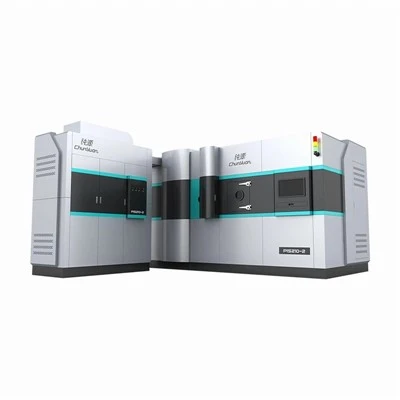
Industrial physical vapor deposition (PVD) platform engineered for high-rate synthesis of dense, wear-resistant, and functional hard coatings. Sustaining a high-current, low-voltage cathodic arc discharge on solid target surfaces generates an 80% to near-100% ionized plasma stream.
Combined with programmable negative substrate biasing, this high kinetic energy drives atomic-scale interfacial mixing, yielding superior film adhesion and zero columnar porosity. The chamber architecture supports modular multi-cathode configurations for automated deposition of single-layer, multi-layer nano-laminates, and stoichiometric gradient coatings (TiN, TiAlN, CrN, TiCN).
Technical Specifications
|
Parameter |
Engineering Specification |
|
Chamber Dimensions |
Custom cylindrical/rectangular (Standard: Phi 800 mm x 1000 mm up to Phi 2000 mm) |
|
Chamber Structure |
Double-walled SUS304/316L stainless steel with integrated spiral cooling water channels |
|
Ultimate Vacuum Pressure |
<= 5.0 x 10^-4 Pa (Backed by magnetic levitation turbomolecular + roots-rotary pump stack) |
|
Pump-Down Cycle |
Atmosphere to 6.0 x 10^-3 Pa in <= 15 minutes |
|
Cathode Arc Sources |
4 to 8 independent DC channels (Phi 85 mm / Phi 100 mm water-cooled target holders) |
|
Arc Power Output |
0-200 A continuously adjustable per channel; integrated microsecond arc quenching |
|
Substrate Bias Supply |
0-1000 V adjustable, Pulsed DC output (frequency range 10-50 kHz) |
|
Substrate Heating |
Quartz infrared lamp array; operational ceiling 600°C (+/- 5°C uniformity) |
|
Fixture Motion |
Planetary or dual-axis rotation via magnetic fluid rotary feedthroughs (0-5 RPM) |
|
Control Architecture |
PLC + Industrial PC (IPC) running real-time recipe execution with hardwired safety interlocks |
Key Features
High Ionization Rate: Direct cathodic vaporization converts metallic flux into high-density ions, promoting dense grain structures without micro-voids.
Active Magnetic Steering: Programmable electromagnetic coils sweep the arc spot across target faces, suppressing localized cratering and driving target material utilization beyond 60%.
Dynamic Gas Control: Closed-loop Mass Flow Controllers (MFCs) regulate reactive gas injection (N2, O2, C2H2) via real-time partial pressure feedback.
Multi-Source Synergy: Chamber walls accommodate hybrid target layouts, allowing uninterrupted sequential deposition of multi-component ceramic layers in a single vacuum cycle.
Vacuum System Configuration
Roughing & Roots Group: Direct-drive rotary vane pump paired with a high-displacement Roots blower to handle high gas loads during reactive processing.
High Vacuum Stage: Magnetic levitation turbomolecular pump (>= 1600 L/s) coupled via a high-conductance pneumatic gate valve.
Vacuum Instrumentation: Interlocked Pirani and Cold Cathode dual-gauge setup monitoring total pressure ranges from atmosphere down to 10^-6 Pa.
Leak Integrity: Elastomer-sealed flanges with water-jacketed cooling maintain system leak rates under 1.0 x 10^-9 Pa*m3/s.
Evaporation Materials & Substrate Compatibility
Cathode Target Materials
Transition Metals & Alloys: Titanium (Ti), Chromium (Cr), Zirconium (Zr), Aluminum (Al), Titanium-Aluminum (TiAl 50/50, 33/67), Tungsten (W).
Non-Metallics: High-purity Graphite (C) for Diamond-Like Carbon (DLC) and carbide layers.
Industrial Substrates
Tool Steels & Carbides: High-Speed Steel (HSS), Cemented Carbides (WC-Co).
Structural Alloys: Austenitic/Martensitic Stainless Steels, Titanium Alloys (TC4), Nickel-based Superalloys (Inconel).
Applications
Precision Cutting Tools: Deposition of TiAlN and AlTiN on drills, end mills, and gear hobs to raise surface hardness to 3300-3500 HV and elevate thermal oxidation resistance up to 800°C.
Automotive Engineering: Low-friction, wear-resistant coatings on fuel injection components, piston rings, and tappets.
Molds and Dies: Chromium nitride (CrN) deposition on plastic injection molds to prevent adhesive wear, micro-welding, and resin sticking.
Customization Options
Chamber Sizing: Geometric modifications tailored for oversized architectural panels or high-throughput small tool carousels.
Source Hybridization: Integration of cathodic arc sources with unbalanced magnetron (UBM) sputtering or HiPIMS cathodes in a unified body.
Automation Interfaces: Factory MES integration via OPC-UA protocols alongside automated loading hatch options.
Quality Control & Factory Testing
Helium Leak Verification: Mass spectrometer leak checking executed on all weldments and vacuum seals.
Electrical Safety Audit: Hipot insulation testing, grounding continuity checks, and E-stop circuit loop verification.
72-Hour Burn-In Test: Continuous dry-run cycling of mechanical rotation drives, water flow switches, and PLC valve sequences prior to disassembly.
Factory Acceptance Testing (FAT): Performed on-site to validate base vacuum levels, arc ignition stability, and baseline thickness distribution on calibration coupons.
Installation & Technical Support
Facility Requirement Handover: Detailed utility drawings specifying floor loading capacity, chilled water specifications (>= 0.3 MPa, 15-25°C), exhaust extraction, and power supply drops (3-phase, 380V/480V).
Field Commissioning: On-site supervision by mechanical and electrical field engineers covering alignment, hookup, and trial batches.
Operator Training: Structured instructions on software recipe configuration, cathode target exchange procedures, and preventive vacuum maintenance.
Remote Diagnostics: Secure industrial VPN gateway embedded in the control panel for software telemetry and troubleshooting support.
Frequently Asked Questions
Q: How does the system handle microdroplets (macroparticles) common in unfiltered cathodic arc processes?
A: Standard configurations utilize optimized electromagnetic steering fields to control arc spot velocity and minimize droplet emission. For semiconductor or optical applications requiring sub-micron defect levels, Filtered Cathodic Arc (FCA) magnetic ducting modules can be integrated to trap neutral macroparticles.
Q: What is the typical target replacement turnaround time?
A: Cathodes utilize quick-release mechanical clamping designs. A trained operator can execute a complete set of target replacements within 30 minutes without breaking structural chamber seals.
Q: Can the system execute automated gradient multi-layer runs without operator intervention?
A: Yes. The PLC recipe engine controls multi-stage recipes, managing transitions in reactive gas partial pressures, substrate bias profiling, and sequential power-channel activation automatically.
Q: What are the exact baseline utility prerequisites for site preparation?
A: The installation site must supply a closed-loop industrial chiller (15-30 kW cooling capacity), clean compressed air (>= 0.6 MPa), high-purity process gases (Ar, N2, C2H2 at >= 99.999% purity), and stable industrial 3-phase power.
Hot Tags: arc evaporation deposition equipment, China arc evaporation deposition equipment manufacturers, suppliers, factory