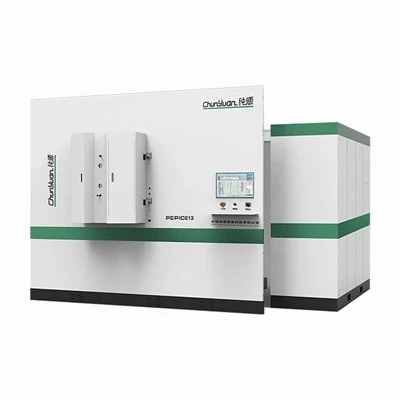
This multi-arc vacuum deposition system utilizes cathodic arc ion plating technology to deposit dense, high-adhesion hard coatings on metallic and non-metallic substrates. By striking a low-voltage, high-current arc on solid cathode targets, material is vaporized and ionized instantly in a vacuum environment. Accelerated by a negative bias voltage, metal ions react with reactive gases (N2, C2H2, O2) to form stoichiometric compound films.
Engineered for industrial tool rooms, automotive component manufacturers, and independent coating service bureaus, the system delivers repeatable film hardness, low friction coefficients, and oxidation resistance. Every machine is configured based on batch throughput, substrate geometry, and target coating architectures (monolayer, multilayer, or gradient).
Technical Specifications
|
Parameter |
Specification Range |
Notes / Configuration Options |
|
Chamber Dimensions |
Custom (e.g., Φ 800 × 1000 mm up to Φ 1500 × 1800 mm) |
304 or 316L stainless steel, double-wall water-cooled jacket |
|
Ultimate Vacuum Pressure |
<= 5.0 × 10^-4 Pa |
Measured via cold cathode and Pirani gauges after 4-hour bake-out |
|
Pump-Down Time |
Atmospheric to 6.0 × 10^-3 Pa in <= 15 minutes |
Dependent on clean chamber status and pump configuration |
|
Cathode Arc Sources |
4 to 12 units (Rectangular or Circular) |
Magnetic confinement design to minimize macroparticle generation |
|
Arc Power Supplies |
DC pulse / Continuous arc, 0–200 A adjustable |
Arc suppression feature to protect targets and substrates |
|
Substrate Bias Power |
Pulsed DC bias (0–1000 V adjustable) |
Enhances ion bombardment energy and coating adhesion |
|
Pumping System |
Rotary vane backing pump + Roots blower + Turbo-molecular / Diffusion pump |
Cryogenic trap optional for oil-free high vacuum |
|
Control System |
PLC + Industrial PC (SCADA) |
Automatic recipe execution, manual override, and data logging |
Key Features
Advanced Magnetic Field Arc Sources: Cathodes incorporate optimized permanent and electromagnetic coils to steer arc spot trajectories, increasing target utilization efficiency to over 55% and reducing droplet emission.
Closed-Loop Gas Flow Control: Mass Flow Controllers (MFCs) regulate reactive gas partial pressures in real-time, maintaining precise stoichiometry for complex compound coatings such as TiAlN and AlCrN.
Planetary Substrate Rotation Mechanism: Multi-axis rotation drive ensures uniform film thickness distribution (tolerance within ± 5%) across complex 3D components and cutting tools.
In-Situ Ion Etching Capability: Integrated glow discharge cleaning and metal ion etching remove native oxides prior to deposition, ensuring scratch-resistant interface bonding.
Modular Electrical Architecture: Standardized terminal blocks and isolated modular power racks simplify field diagnostics and minimize mean time to repair (MTTR).
Vacuum System Configuration
Thin-film deposition relies on baseline vacuum integrity and gas handling dynamics, executed via a staged pumping stack:
Roughing & Intermediate Stage: Direct-drive rotary vane mechanical pumps paired with roots blowers evacuate the chamber from atmospheric pressure to the transition range (10^-1 Pa).
High Vacuum Stage: Turbo-molecular pumps (or oil diffusion pumps equipped with liquid nitrogen cold traps) achieve an ultimate base pressure below 5.0 × 10^-4 Pa, eliminating residual water vapor and oxygen contamination.
Sealing & Valve Assembly: Pneumatic high-vacuum gate valves, elastomer/metal-sealed flanges (ISO/CF), and helium leak-tested weldments (< 1.0 × 10^-10 Pa·m3/s) prevent atmospheric outgassing during long coating cycles.
Evaporation Materials & Substrate Compatibility
Target Materials
Pure Metals: Ti, Cr, Al, Zr, Cu, Mo, Stainless Steel
Alloys: TiAl, CrAl, SiAl, WC-Co
Substrate Materials
Tool Steels: H13, M2, D2, high-speed steel (HSS)
Cemented Carbides: WC-Co inserts and end mills
Structural Metals: Titanium alloys, stainless steel, brass, and aluminum (requires low-temperature deposition protocols)
Applications
Cutting & Forming Tools: Deposition of TiN, TiAlN, and AlCrN on end mills, drills, hobbing cutters, and stamping dies to increase surface hardness up to 3000 HV and extend tool life by 3x–5x.
Automotive Components: Low-friction coatings (DLC or CrN) applied to piston rings, fuel injection pins, and tappets to reduce mechanical wear and parasitic power loss.
Hardware & Sanitary Ware: Decorative, wear-resistant hard gold, rose gold, black (TiCN, ZrN), and stainless steel tones applied to architectural door hardware and bathroom fixtures with proven salt spray corrosion resistance (> 240 hours).
Customization Options
Chamber Geometry: Vertical loading (pit-mounted or floor-standing) or horizontal front-loading configurations.
Hybrid Deposition Integration: Combine cathodic arc sources with High-Power Impulse Magnetron Sputtering (HIPIMS) or unbalanced magnetron sputtering (UBM) cathodes in a single chamber for hybrid functional layers.
Automation Interface: Custom SCADA software integration with factory MES (Manufacturing Execution System) for remote batch tracking and automated loading robot handshakes.
Utility Adaptations: Factory-specific cooling water temperature/pressure adjustments and localized power grid voltage compliance (e.g., 380V/480V, 50Hz/60Hz, 3-phase).
Quality Control & Factory Testing
Vacuum Leak Detection: Helium mass spectrometer leak testing performed on all chamber bodies, weld seams, and valve manifolds.
Electrical Safety Audit: Insulation resistance, grounding continuity, and high-potential (hipot) testing executed in compliance with CE/UL electrical norms.
Functional Dry Run: 72-hour continuous cycling test of mechanical rotation drives, pneumatic valves, and heating elements without target ignition.
Sample Deposition Verification: Trial coating run performed using client-supplied substrates; samples evaluated via ball-crater test (adhesion) and Calotest/XRR (film thickness measurement).
Installation & Technical Support
Pre-Installation Guide: Detailed Foundation and Utility Layout Drawings provided covering floor loading specifications, cooling water flow rates (m3/h), exhaust duct requirements, and electrical busbar sizing.
On-Site Commissioning: Field engineers dispatched for mechanical alignment, vacuum leak checking, electrical hookup, initial process recipe tuning, and operator training.
Documentation Package: Complete delivery includes electrical schematics, PLC source logic summaries, vacuum component manuals, maintenance troubleshooting trees, and consumable replacement schedules.
Remote Diagnostic Support: Secure VPN-enabled router integration allowing process engineers to log into the HMI interface for real-time parameter diagnosis and software updates.
Spare Parts Inventory: Dedicated stock of critical replacement items (cathode targets, insulators, valve seals) maintained for rapid dispatch to minimize line downtime.
Frequently Asked Questions
Q: How do you minimize macroparticles (droplets) inherent to cathodic arc evaporation?
A: Systems use steering magnetic fields to rapidly move the arc cathode spot, preventing localized overheating and large droplet emission. Optional curved-duct filtered cathodic arc (FCAN) sources can be integrated for droplet-sensitive applications.
Q: What is the typical lead time for manufacturing a custom vacuum coating system?
A: Standard chamber configurations require 12 to 16 weeks from design sign-off to factory readiness. Highly customized multi-source hybrid systems require 18 to 22 weeks.
Q: What utility requirements must be prepared before delivery?
A: Facilities require a closed-loop chilled water supply (15–30 tons capacity dependent on chamber size), compressed air (0.5–0.7 MPa), high-purity process gases (N2, Ar, C2H2 at 99.999% purity), and adequate electrical main breaker capacity.
Q: What routine maintenance consumables are required?
A: Primary consumables include cathode targets, shielding plates, dark space shields, mechanical pump oil, and diffusion pump fluid. Maintenance intervals scale directly with daily operating hours.
Hot Tags: multi-arc vacuum deposition equipment, China multi-arc vacuum deposition equipment manufacturers, suppliers, factory, reliable thin film equipment, thin film dipping equipment, thin film equipment for electronics, thin film equipment for renewable energy, thin film evaporation system, thin film laminating equipment