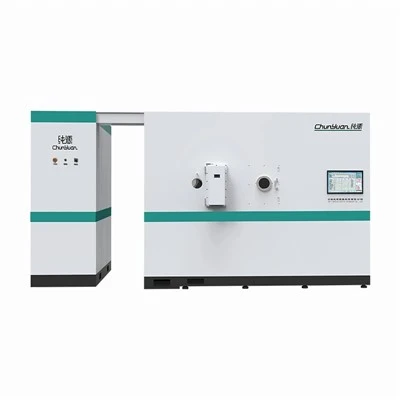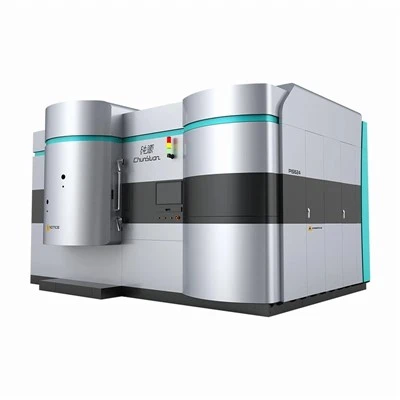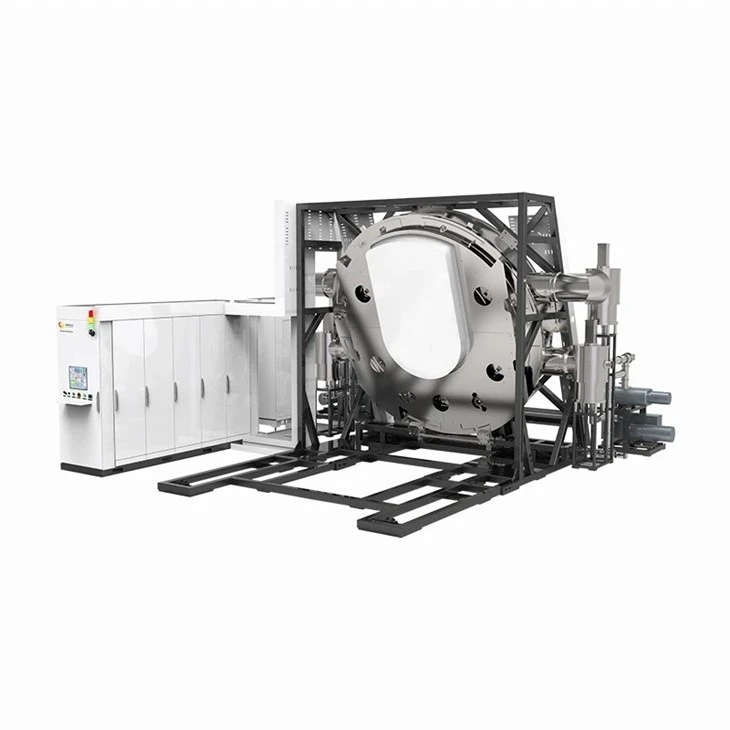
Industrial-grade vacuum coating system integrating magnetron sputtering (RF/DC/HiPIMS) and cathodic arc evaporation. Designed for continuous, multi-layer, alloy, and nano-composite thin-film deposition at production scale.
Technical Specifications
|
Parameter |
Specification Value |
|
Ultimate Vacuum Pressure |
<= 5.0 x 10^-4 Pa (Turbo-molecular and roots-rotary pump configuration) |
|
Chamber Dimensions |
Custom sizing from D 600 mm x 600 mm to D 1500 mm x 1500 mm (304/316L electro-polished stainless steel) |
|
Deposition Sources |
Configurable: 2-6 magnetron sputtering cathodes / 2-4 arc sources |
|
Substrate Bias Power |
0 to -1000 VDC adjustable (pulsed DC for dielectric substrates) |
|
Film Thickness Uniformity |
<= +/- 3% across standard planar holder (via dynamic planetary rotation) |
|
Substrate Temperature |
Ambient to 650°C (+/- 2°C PID closed-loop control) |
|
Power Distribution |
RF (13.56 MHz), DC, Pulsed DC, and Mid-Frequency (MF) with arc suppression |
Key Features
Dual-Technology Integration: Combines sputtering (smooth, amorphous compound films) and cathodic arc (high-ionization metal/alloy deposition) in one pump-down cycle.
Closed-Loop Gas Management: Mass Flow Controllers (MFCs) paired with optical emission monitoring (OEM) stabilize reactive gas partial pressures.
Mechanical Isolation: Multi-axis planetary drives isolate mechanical bearings from the process zone, preventing particulate contamination.
Thermal Architecture: Double-walled water-cooled chamber walls and radiation shielding prevent thermal distortion during high-power operation.
Automation Core: Siemens S7-1500 PLC and WinCC SCADA architecture for real-time interlock, gas, and power monitoring.
Vacuum System Configuration
Roughing Train: Direct-drive rotary vane pumps backed by Roots blowers with magnetic fluid seals.
High Vacuum: Magnetically levitated turbo-molecular pumps (1200 - 3200 L/s) or cryogenic pumps.
Diagnostics: Integrated Helium mass spectrometer test ports and automated sequencing interlocks.
Materials & Substrate Compatibility
Target Materials:
Metals: Ti, Cr, Al, Zr, Cu, TiAl, CrAl, Si
Ceramics/Compounds: TiN, CrN, TiAlN, DLC, Al2O3, SiO2
Substrates: Tool Steels (H13, M2, carbide inserts), Titanium/Aluminum structural alloys, engineering ceramics, and silicon wafers.
Applications & Proven Performance
Cutting Tools: Low-friction, high-hardness multi-layer coatings (TiAlN/TiN) for extended tool life under dry high-speed machining.
Automotive: Wear and anti-scuffing coatings for piston rings and fuel injection pins.
Aerospace: Oxidation-resistant thermal barrier and protective films on compressor blades and fasteners.
Optics & Electronics: Conductive transparent oxides (ITO) and optical interference filters.
Customization Options
Chamber Geometry: Rectangular box configurations for batch rack loading or cylindrical inline geometries.
Source Retrofitting: Interchangeable cathode mounting flanges for field conversion to CFUBMS.
Plasma Etching: Kaufmann-type ion guns or hollow cathode sources for in-situ substrate cleaning.
Quality Control & Factory Testing
Vacuum Integrity: Helium leak test threshold <= 1 x 10^-9 Pa*m^3/s.
Surface Finish: Chamber internal welds electro-polished to Ra <= 0.4 um.
FAT: 72-hour continuous dry-run test of vacuum, motion, and safety interlock loops prior to crating.
Compliance Standards: Built to CE machinery directives and ISO 9001 standards. (Trust Badge Icons: ISO 9001, CE, UL)
Installation & Technical Support
Documentation Bundle: P&ID schematics, electrical wiring diagrams, PLC source logic, and CE/UL compliance dossiers.
Commissioning: Field engineers supervise mechanical positioning, utility hookups, and leak check verification.
SAT & Recipe Handover: On-site baseline test runs and recipe optimization.
FAQ
Q: What is the pump-down time to base pressure?
A: Reaches < 5.0 x 10^-4 Pa within 45 minutes under clean, dry, and ambient thermal conditions.
Q: Can the system switch between DC and RF sputtering mid-process?
A: Yes. The power matrix allows software-controlled sequencing between DC, pulsed DC, and RF without breaking vacuum.
Q: What utilities are required on-site?
A: Chilled water (15 to 20°C at 0.3 to 0.4 MPa), compressed air (0.6 MPa), high-purity process gases (Ar, N2, O2 at 99.999%), and dedicated 3-phase industrial power.
Q: How is substrate temperature regulated during deposition?
A: Integrated infrared pyrometers coupled with radiant heater banks and PID closed-loop control.
Hot Tags: pvd composite thin film system, China pvd composite thin film system manufacturers, suppliers, factory