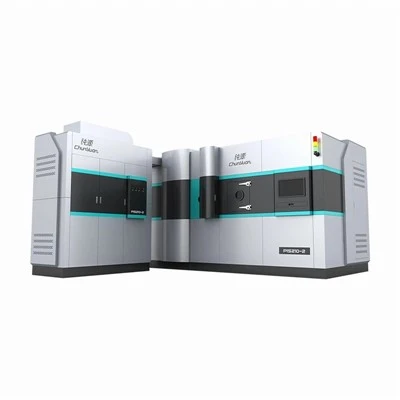
Industrial PVD Composite Deposition Equipment is engineered for multi-component, multi-layer, and nano-composite thin-film fabrication. The system integrates thermal evaporation, e-beam evaporation, and magnetron sputtering sources within a single vacuum environment to control film composition, interface sharpness, and residual stress. Built for continuous R&D and production, the architecture features low base pressure, modular source configuration, and clean maintenance access.
Technical Specifications
|
Parameter |
Specification Range / Value |
|
Ultimate Vacuum Pressure |
<= 5.0 x 10^-5 Pa (cryo/turbomolecular configuration) |
|
Pump-Down Time |
Atmospheric to 6.0 x 10^-4 Pa in <= 15 minutes (clean, dry, empty chamber) |
|
Substrate Holder Size |
Custom configurations: up to Dia. 600 mm flat plate or planetary stages |
|
Film Thickness Uniformity |
< +/- 1.5% across standard working area (verified via in-situ optical monitoring) |
|
Substrate Temperature Range |
Ambient to 800 deg.C (PID controlled, quartz halogen/resistive heating) |
|
Deposition Sources |
Multi-pocket e-beam guns, thermal boats, and RF/DC magnetron cathodes |
|
Chamber Material |
304L/316L stainless steel, electro-polished inner walls (Ra <= 0.2 um) |
|
System Control Interface |
PLC + IPC architecture, automated recipe execution, SCADA logging |
Key Features
Modular Source Integration: Chamber ports accommodate simultaneous or sequential operation of evaporation and sputtering sources without cross-contamination.
Dynamic Substrate Manipulation: Multi-axis planetary or swing rotation drive mechanisms ensure conformal coating on complex 3D substrates and deep trenches.
In-Situ Monitoring Ports: Pre-aligned flanges for quartz crystal microbalance (QCM), optical emission spectroscopy (OES), and broadband optical monitoring (BOM).
High-Purity Vacuum Integrity: Metal-sealed conflat (CF) flanges, pneumatic gate valves, and Helium mass spectrometer leak testing down to 1.0 x 10^-10 Pa*m3/s.
Automated Interlock Safety: Real-time sensor feedback protects against cooling water failure, compressed air loss, and over-temperature anomalies.
Vacuum System Configuration
Roughing & Roots Pumps: Oil-free dry screw pumps combined with roots blowers prevent hydrocarbon backstreaming into the process chamber.
High-Vacuum Pumps: Magnetically levitated turbomolecular pumps or closed-loop helium cryogenic pumps selected per target gas load requirements.
Pressure Regulation: Throttle valve controllers integrated with capacitance manometers maintain stable process pressure (0.1 Pa to 10 Pa) during reactive runs.
Materials & Substrate Compatibility
Deposition Materials
Metals: Ti, Al, Cr, Cu, Au, Ag, Ni, Mo, W, Pt
Oxides & Dielectrics: SiO2, TiO2, Ta2O5, Al2O3, HfO2
Nitrides & Carbides: TiN, TiAlN, CrN, Si3N4
Substrate Materials
Semiconductors: Silicon wafers (100 mm to 300 mm), glass, quartz, sapphire
Metals & Alloys: Stainless steel, titanium alloys, tool steels, superalloys
Ceramics & Polymers: Alumina, zirconia, polyimide films
Applications
Optical Interference Filters: Multi-layer anti-reflective (AR) coatings, bandpass filters, and high-reflector mirrors for lasers and sensors.
Wear-Resistant Hard Coatings: Nanocomposite nitride coatings (TiAlN/Si3N4) on precision cutting tools and automotive valvetrains.
Microelectronic Thin Films: Conductive barrier layers, seed layers, and contact metallization stacks for semiconductor packaging.
Functional Energy Films: Transparent conductive oxides (TCO) and absorber layers for photovoltaic and sensor devices.
Customization Options
Chamber Dimensions: Scaled volume from R&D scale (400 mm cube) to production scale (Dia. 1200 mm cylindrical).
Source Port Layouts: Custom flange positioning to integrate third-party ion sources, plasma-assisted deposition (PAD), or RF bias generators.
Load-Lock Integration: Manual load-lock, single-wafer load-lock, or multi-chamber cluster tool configurations to prevent oxidation.
Quality Control & Global Compliance
Global Electrical & Safety Compliance: Control cabinets built to UL 508A / NFPA 79 (North America), CE (Europe), and SEMI S2/S8 EHS guidelines.
Vacuum Testing: Welded chambers undergo Helium mass spectrometer leak detection prior to surface finishing.
Dimensional Inspection: Coordinate measuring machine (CMM) verification of source mounting planes and substrate tolerances.
Factory Acceptance Test (FAT): 72-hour continuous dry-run test recording base pressure decay, pump-down curves, and PLC response logs.
Installation & Technical Support
Pre-Installation Engineering: Provision of facility requirement manuals (utilities, cooling water flow/pressure, exhaust ventilation, cleanroom floor loading).
On-Site Commissioning: Field service engineers oversee rigging, vacuum line hookup, electrical tie-in, and initial pump-down.
Process Tuning Assistance: Collaborative trial runs with customer engineering teams to verify film uniformity and deposition rates.
Lifecycle Support: Remote diagnostics module integration for real-time PLC troubleshooting, supported by localized spare parts inventory.
Frequently Asked Questions
Q: What is the lead time for a custom system?
A: Standard configurations require 16 to 24 weeks from drawing approval to factory readiness, depending on vacuum pump lead times.
Q: How is cross-contamination managed during multi-source co-deposition?
A: Chambers incorporate physical shielding between sources, individual source shutters, and directional gas distribution rings to prevent particulate migration.
Q: Can this equipment be integrated into a cleanroom facility?
A: Yes. Systems support through-the-wall (yellow room / cleanroom) installation, placing the process chamber inside the cleanroom and utility racks in the service chase.
Q: What utility requirements must be prepared prior to delivery?
A: Requirements include 3-phase power (configured to local 480V/380V standards), chilled cooling water (18 deg.C to 22 deg.C, >= 3 bar), compressed air (6 bar dry/filtered), and a dedicated roughing pump exhaust line.
Hot Tags: pvd composite deposition equipment, China pvd composite deposition equipment manufacturers, suppliers, factory