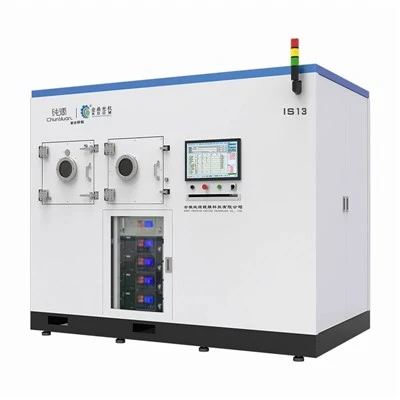
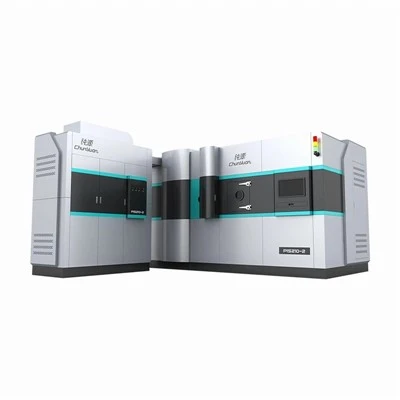
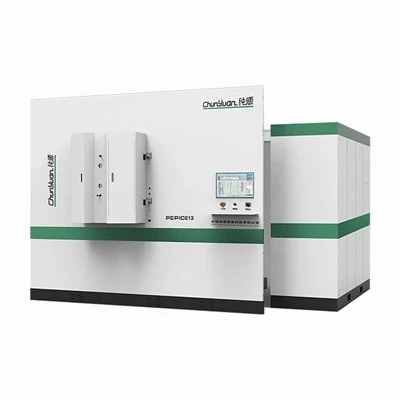
The industrial cathodic arc evaporation PVD system utilizes low-voltage, high-current electrical arcs to vaporize solid cathode targets in a vacuum environment. This mechanism achieves a metal ionization rate exceeding 80%, ensuring high chemical bonding strength and substrate adhesion compared to thermal evaporation or standard magnetron sputtering.
Engineered for continuous multi-shift production, the system integrates a heavy-gauge stainless steel vacuum chamber, modular cathode steering assemblies, and a PLC-based automated process control architecture.
Technical Specifications
|
Technical Parameter |
Specification Range / Value |
|
Chamber Dimensions |
Custom configurations: Phi 800 mm x 1000 mm to Phi 2000 mm x 2200 mm |
|
Chamber Material |
Double-walled SUS304 or SUS316L stainless steel, water-cooled jacket |
|
Ultimate Vacuum Pressure |
<= 5.0 x 10^-4 Pa (after bakeout and outgassing) |
|
Pumping System Setup |
Rotary vane roughing pump + Roots blower + Turbo-molecular / Diffusion pump |
|
Arc Power Supply |
Adjustable DC arc current: 0 - 200 A per channel; ignition voltage: 380 V |
|
Substrate Bias Power |
Pulsed DC bias: 0 - -1000 V, frequency 10 - 100 kHz |
|
Cathode Sources |
4 - 12 magnetic-confinement circular or rectangular arc sources |
|
Substrate Rotation |
Planetary or double-axis rotation driven by high-torque magnetic fluid feedthrough |
|
Operating Temperature |
Ambient to 600 deg C with PID-controlled radiant heaters |
|
Control System |
Siemens S7-1500 PLC + Industrial PC running SCADA software |
Key Features
High Ionization Efficiency: Direct cathode vaporization produces fully ionized metallic plasma for dense, defect-controlled thin-film growth at moderate temperatures.
Magnetic Filtered Arc Option: Integrated electromagnetic steering coils minimize macroparticle (droplet) ejection to deliver smooth coating finishes for precision tooling.
Multi-Layer / Gradient Deposition: Synchronous multi-cathode operation enables the synthesis of graded transition layers (e.g., Ti/TiN/TiAlN) without breaking vacuum.
Closed-Loop Process Control: Real-time feedback loops regulate reactive gas flow (nitrogen, acetylene, oxygen) via high-precision mass flow controllers (MFCs) to maintain target partial pressures.
Vacuum System Configuration
Pumping Stack: Primary roughing utilizes dual-stage rotary vane pumps backed by Roots blowers. High-vacuum attainment relies on high-throughput diffusion pumps or turbomolecular pumps.
Valves & Piping: Pneumatic angle valves and electropneumatic gate valves isolate chamber zones automatically. Manifolds use ISO/KF and CF flanged stainless steel tubing with silver-plated copper seals or Viton O-rings.
Leak Detection: Integrated helium mass spectrometer test ports enable diagnostics down to 10^-10 Pa*m^3/s.
Evaporation Materials & Substrate Compatibility
Compatible Cathode Materials
Pure Metals: Ti, Cr, Al, Zr, Cu, Mo, W, Ag, TiAl alloys (e.g., 50/50 or 33/67 atomic ratios).
Compound Targets: TiC, CrC, WC.
Substrate Compatibility
Tool Steels: High-speed steels (M2, H13) and cemented carbides (WC-Co inserts).
Structural Alloys: Stainless steel, titanium alloys (TC4), and nickel-based superalloys.
Engineering Ceramics: Silicon nitride and alumina with conductive pre-treatment.
Applications & Verified Performance Metrics
Cutting & Forming Tools: TiN, TiAlN, and AlTiN coatings on carbide drills and milling cutters. Achieves surface hardness >= 3000 HV and extends tool wear life by 200% - 400%.
Automotive Components: Anti-wear coatings on piston rings, tappets, and fuel injector needles. Lowers the coefficient of friction to 0.15 - 0.25 against steel.
Medical Implants: Biocompatible TiN and ZrN layers applied to orthopedic joints and dental abutments, verified via scratch adhesion testing (Critical Load Lc >= 70 N).
Molds & Dies: CrN or DLC coatings on plastic injection and stamping molds to eliminate adhesive wear and ease workpiece release.
Customization Options
Chamber Geometry: Vertical pit-type loading or horizontal front-loading configurations.
Source Layout: Custom cathode positioning tailored for 3D workpiece geometries (e.g., long extrusion dies or turbine blades).
Bias Generator Upgrades: Integration of high-power impulse magnetron sputtering (HIPIMS) hybrid modules.
Automation Integration: Robotic loading interfaces and automated fixture transfer rails for cleanroom environments.
Quality Control & Factory Testing
Prior to Factory Acceptance Testing (FAT), systems undergo:
Vacuum Leak Testing: Helium mass spectrometer verification on all welds and seals.
Electrical Safety Verification: Insulation resistance, ground continuity, and interlock logic checks conforming to CE/UL standards.
Functional Burn-in: 72-hour continuous dry-run test of rotation drives, flow switches, and PLC communication.
Coating Test Run: Sample deposition verified via ball-crater film thickness measurement and Rockwell indentation scratch testing.
Installation & Technical Support
Site Preparation: Comprehensive utility layout documentation covering cooling water flow (> 15 m^3/h, 20 - 25 deg C), compressed air, ventilation, and electrical drops (380V/480V, 3-phase, 50/60 Hz).
Commissioning: On-site installation, vacuum calibration, and recipe optimization by senior process engineers.
Operator Training: Hands-on instruction covering routine maintenance, target replacement, and SCADA operation.
After-Sales Support: Remote diagnostic access via secure industrial VPN; guaranteed technical response within 24 hours.
Frequently Asked Questions
Q: What is the typical turnaround time for cathode target replacement?
A: Quick-release mechanical clamping flanges allow an operator to replace spent targets within 30 - 45 minutes per source without dismantling internal chamber shielding.
Q: Can the control system store multiple recipe profiles?
A: Yes. The Siemens industrial PLC stores up to 100 distinct recipes, tracking cleaning bias, heating duration, reactive gas ramps, arc current levels, and deposition timing.
Q: What utility infrastructure must be provisioned on-site?
A: Facilities require a closed-loop chilled water system, compressed air (0.6 - 0.8 MPa) for pneumatic valves, stable 3-phase industrial power feeds matching total connected load, and local exhaust extraction lines.
Hot Tags: arc evaporation pvd equipment, China arc evaporation pvd equipment manufacturers, suppliers, factory, DLC Metal Coating Equipment, new generation thin film equipment, thin film equipment for photonics manufacturing applications, thin film equipment for quantum computing, thin film semiconductor system, thin film sensor system