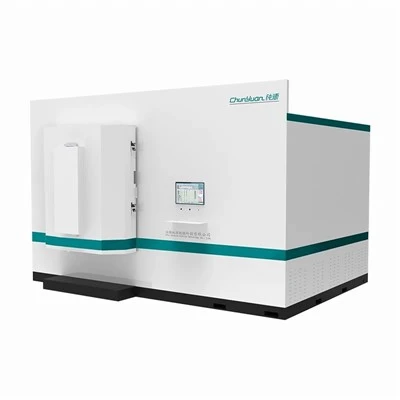
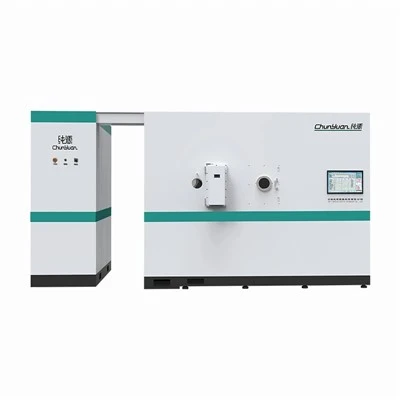
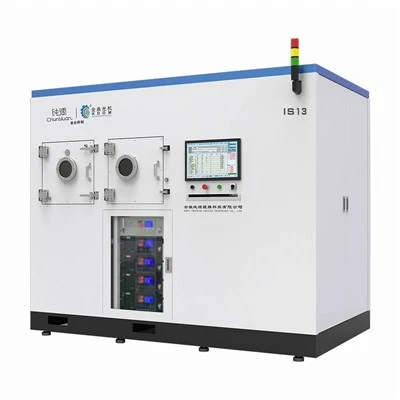
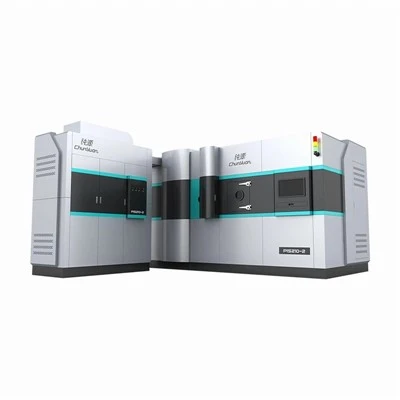
The Industrial Cathodic Arc Evaporation Thin Film System is engineered for the high-rate deposition of dense, strongly adherent metallic, alloy, and ceramic compound coatings. Operating via a low-voltage, high-current arc discharge on solid cathode targets, the system vaporizes material directly into a highly ionized plasma state (40% - 80% metal ion ratio). This drives energetic ions into the substrate interface, producing superior coating adhesion compared to standard thermal evaporation or conventional sputtering methods.
Built for production environments and advanced material research centers, the system deposits hard, wear-resistant tribological layers-such as TiN, TiAlN, CrN, and AlCrN-onto cutting tools, forming molds, and precision mechanical components. The modular vacuum chamber accommodates scalable multi-cathode configurations and automated 3-axis planetary rotation to ensure batch-to-batch repeatability.
Technical Specifications
|
Technical Parameter |
Specification Range / Value |
|
Ultimate Vacuum Pressure |
<= 5.0 x 10^-4 Pa (achieved via turbomolecular and rotary/dry backing pump combination) |
|
Chamber Dimensions |
Customized inner diameter (Standard industrial models: dia. 600 mm to dia. 1200 mm) |
|
Chamber Material |
Double-wall SUS304 stainless steel with internal helical water-cooling channels |
|
Arc Power Supplies |
DC Arc Generators: 10A - 200A adjustable; Pulsed Arc options available |
|
Substrate Bias Power |
-100V - -1000V adjustable pulsed bias power supply (10kHz - 100kHz) |
|
Cathode Sources |
2 - 6 interchangeable magnetic-steering cathode stations (dia. 85 mm or dia. 100 mm) |
|
Substrate Rotation |
3-axis planetary rotation drive with variable speed control (0 - 10 rpm) |
|
Total Connected Power |
45kVA - 120kVA (dependent on chamber volume and source count) |
|
Cooling Water Requirement |
Flow rate: 15 - 40 m^3/h; Pressure: 0.2 - 0.3 MPa; Temp: 18 - 25 deg C |
Key Features
Magnetic-Steering Cathode Technology: Closed-loop magnetic fields sweep the cathode spot across the target surface, raising target utilization rates above 55% and suppressing localized target cratering.
High Ionization Rate PlasmGenerates metal ion ratios up to 80%, providing high kinetic energy for dense film growth and deep metallurgical diffusion at the substrate interface.
Programmable Multi-Layer Deposition: Industrial PLC combined with an HMI control architecture executes automated sequencing of reactive gases (N2, O2, C2H2) for functional gradient and nanolayered coating architectures.
In-Situ Plasma Etching: Integrates metal ion bombardment and unbalanced magnetron cleaning stages prior to deposition to remove native oxides and surface contaminants.
Vacuum System Configuration
The vacuum subsystem is engineered for rapid pump-down cycles and stable operational pressure under continuous reactive gas input:
Roughing & Roots Stage: Direct-driven rotary vane or dry screw pump paired with a Roots blower, evacuating the chamber from atmospheric pressure to 10 Pa within 5 minutes.
High Vacuum Stage: Magnetic levitation turbomolecular pump delivering high volumetric pumping speed for water vapor and residual gases, securing base pressure targets below 5.0 x 10^-4 Pa.
Valves & Gauging: Pneumatic gate valves and electro-pneumatic angle valves integrated with full-range Pirani/Penning combination gauges for automated safety interlocks.
Pressure Regulation: Closed-loop capacitance manometer feedback connected to high-precision mass flow controllers (MFCs) to stabilize reactive gas partial pressure during reactive deposition.
Evaporation Materials & Substrate Compatibility
Target Materials
Pure Metals: Ti, Cr, Al, Zr, Cu, Mo, W, Nb.
Alloy Targets: TiAl (50/50, 33/67), TiSi, CrAl.
Carbon: Graphite targets for diamond-like carbon (DLC) hybrid deposition.
Substrate Compatibility
Hardmetals / Cemented Carbides: WC-Co cutting inserts, end mills, and form tools.
High-Speed Steels (HSS): Taps, twist drills, and broaches.
Engineering Steels: Stainless steel, titanium alloys, and high-temperature nickel-based superalloys.
Structural Ceramics: Alumina and silicon nitride components requiring tribological modification.
Applications
Cutting & Machining Tools: Deposition of TiAlN and AlCrN coatings on carbide inserts to elevate oxidation resistance up to 900 deg C and extend tool life during high-speed dry cutting.
Automotive Components: Hard coating of piston rings, valve lifters, and fuel injection pins to reduce boundary friction coefficients below 0.1 and prevent scuffing.
Moulds & Dies: Application of CrN and TiCN films on plastic injection molds and metal stamping dies to prevent adhesive wear and material galling.
Aerospace Hardware: Protective erosion-resistant coatings on precision fasteners and compressor components operating in corrosive environments.
Customization Options
Chamber Geometry: Vertical pit-style loading or horizontal front-loading door designs tailored to shop-floor layouts.
Hybrid Source Integration: Dual-technology configurations combining cathodic arc evaporators with unbalanced magnetron sputtering (UBMS) cathodes or linear ion guns.
Automation Level: Factory integration options including automated robotic loading arms or cleanroom partition wall mounting.
Power Electronics: Customized pulsed bias generators optimized for insulating substrates or temperature-sensitive base materials.
Quality Control & Factory Testing
Leak Detection: Helium mass spectrometer leak testing performed on all vacuum chambers and weld seams, maintaining total leak rates below 1.0 x 10^-9 Pa*m^3/s.
Electrical Safety Audit: Insulation resistance and grounding continuity testing compliant with CE and electrical safety standards.
Functional Dry Run: 72-hour continuous automated dry cycle test of mechanical rotation drives, valve sequencing, and cooling water flow interlocks.
Process Verification (FAT): Optional deposition of reference TiN coatings on client-supplied test coupons to verify film thickness uniformity, nano-hardness, and scratch adhesion strength prior to crating.
Installation & Technical Support
Site Preparation Guide: Detailed facility engineering documentation covering floor loading limits, exhaust ducting, chilled water specifications, and electrical drops provided 4 weeks prior to delivery.
On-Site Commissioning: Field service engineers supervise mechanical positioning, utility hookups, vacuum sealing, and electrical integration.
Process Training: Hands-on operator training covering chamber maintenance, target replacement protocols, vacuum troubleshooting, and recipe management.
Remote Diagnostics: Secure industrial VPN gateway integrated into the control cabinet for remote software updates, parameter logging analysis, and fault diagnosis.
FAQ
Q: How does the system control macroparticle (droplet) generation inherent to cathodic arc evaporation?
A: The system incorporates steering magnetic fields to rapidly sweep the cathode spot across the target surface, reducing macroparticle formation. For applications requiring ultra-smooth surfaces (Ra < 0.05 um), macroparticle filter ducts (filtered cathodic arc) or hybrid magnetron sputtering configurations can be integrated.
Q: What is the typical target utilization rate, and how are targets replaced?
A: Utilizing magnetic-steering technology, target utilization ranges between 50% and 60%. Cathodes are designed with quick-clamp mechanisms, allowing a trained operator to complete target replacement and cathode cleaning within 30 minutes per station.
Q: Can the system run automated multi-layer or gradient coating processes?
A: Yes. The industrial PLC and HMI system store up to 100 recipe profiles. It automatically regulates gas mass flow controllers, arc current ramps, and bias voltage pulsing to deposit complex architectural layers (e.g., bonding layer -> gradient layer -> functional nano-multilayer) without operator intervention.
Q: What are the utility requirements for a standard dia. 900 mm system?
A: A standard dia. 900 mm unit requires a 3-phase 380V/480V (50/60Hz) power supply with a peak load of approximately 75kVA, a closed-loop chilled water supply (25 m^3/h at 0.25 MPa), and a clean, dry compressed air supply (0.6 MPa) for pneumatic valve actuation.
Hot Tags: arc evaporation thin film system, China arc evaporation thin film system manufacturers, suppliers, factory