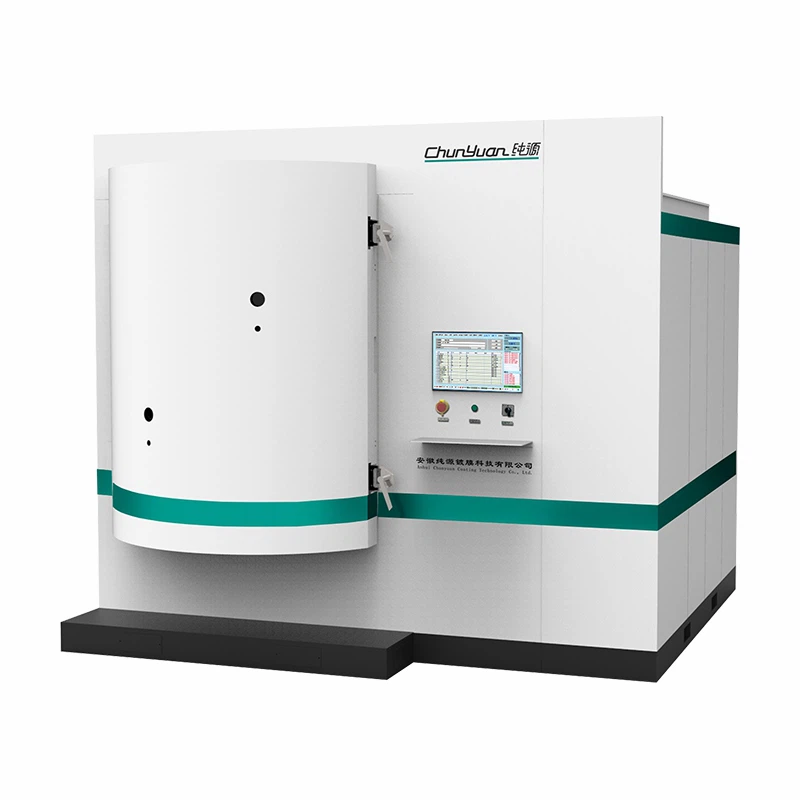
The PVD Multi-Process Thin Film Equipment is an integrated vacuum deposition platform engineered to combine multiple thin-film fabrication techniques-including RF/DC Magnetron Sputtering, Thermal Evaporation, and Electron Beam Evaporation-within a unified vacuum architecture.
This system eliminates vacuum break contamination between distinct process layers, enabling the deposition of complex multi-layer metallic, dielectric, and semiconductor films without ambient exposure. Configured for laboratory R&D clusters or pilot-line production, it accommodates substrates up to 300mm in diameter or customized carriers.
Technical Specifications
|
Parameter |
Specification Details |
|
Ultimate Base Pressure |
< 5.0 x 10^-6 Pa (Achieved via Turbo-Molecular and Cryogenic Pumping) |
|
Chamber Material |
304L / 316L Stainless Steel, Electro-Polished (Ra < 0.25 um) |
|
Substrate Compatibility |
Silicon Wafers (up to 300mm), Glass, Quartz, Metal Foils, Flexible Substrates |
|
Deposition Sources |
Up to 4 Sputter Cathodes (2-inch to 4-inch), 2 E-Beam Pockets, 2 Thermal Boats |
|
Film Uniformity |
+/- 1% across a 200mm substrate area (rotation-assisted) |
|
Substrate Heating |
Ambient to 800 C with PID closed-loop temperature control |
|
Power Supplies |
DC (up to 5kW), RF (13.56MHz, up to 2kW), Pulsed DC for reactive sputtering |
|
System Control |
PLC + Industrial PC, SCADA software, full recipe automation and manual override |
Key Features
Modular Vacuum Architecture: Independent process chambers coupled via gate valves prevent cross-contamination between reactive sputtering and high-vacuum evaporation.
In-Vacuum Substrate Transfer: Magnetic or linear transfer arms maintain high vacuum (< 10^-4 Pa) during inter-chamber sample movement.
Quick-Change Source Flanges: Sputter cathodes and e-beam crucibles are mounted on standard CF flanges for rapid maintenance and target replacement.
Advanced Cryogenic Trapping: Integrated liquid nitrogen cold traps and Meissner traps minimize residual water vapor pressure inside the chamber.
Closed-Loop Thickness Monitoring: Dual quartz crystal microbalance (QCM) sensors provide real-time deposition rate and thickness feedback linked directly to power supply regulation.
Vacuum System Configuration
Roughing Stage: Oil-free scroll pumps paired with multi-stage roots blowers to eliminate hydrocarbon back-streaming.
High Vacuum Stage: Backed by magnetically levitated turbo-molecular pumps (> 1200 L/s for N2) and optional cryopumps for high water-vapor throughput.
Pressure Regulation: Baratron capacitance manometers for absolute pressure measurement independent of gas species, paired with automated throttle valves for precise process gas pressure control (0.1 Pa to 10 Pa).
Leak Detection: Helium leak-tested to < 1 x 10^-9 Pa*m^3/s prior to factory acceptance testing (FAT).
Evaporation Materials & Substrate Compatibility
Conductive Targets: Au, Ag, Cu, Al, Ti, Cr, ITO, AZO, Mo, W, NiCr.
Dielectric Materials: SiO2, TiO2, Al2O3, Ta2O5, HfO2 (via reactive sputtering or e-beam).
Substrate Types:
Semiconductor wafers (Silicon, Gallium Arsenide, Indium Phosphide).
Optical blanks (Fused silica, BK7, Sapphire).
Flexible webs and thin metal sheets (Polyimide, stainless steel foil).
Applications & Verified Performance Data
Optoelectronics: Deposition of transparent conductive oxide (TCO) layers and anti-reflective (AR) optical filter stacks.
Semiconductor Device Fabrication: Formation of ohmic contacts, Schottky barriers, seed layers for electroplating, and diffusion barriers (Ti/TiN).
Sensor Manufacturing: Thin-film metallic strain gauges, micro-heater elements, and piezoelectric transducers.
Advanced R&D: Exploratory multi-layer thin-film synthesis for quantum computing components and novel energy storage materials.
Customization Options
Chamber Geometry: Expanding chamber dimensions for non-standard or oversized batch substrates.
Source Integration: Custom allocation ratios between magnetron sputtering guns and electron beam evaporation pockets.
Bias Sputtering: Substrate RF/DC biasing options for film densification and stress control.
Load-Lock Integration: Addition of automated load-lock chambers to maintain high vacuum integrity during high-throughput loading cycles.
Quality Control & Factory Testing
Material Traceability: Mill test certificates (MTCs) provided for all vacuum-side stainless steel components and structural frames.
Cleanroom Assembly: Final integration and particle-count verification performed in an ISO Class 6 cleanroom environment.
Factory Acceptance Testing (FAT): 72-hour continuous vacuum bake-out test, leak testing via residual gas analyzer (RGA) mass spectrometry, and baseline film deposition run verifying thickness uniformity.
Installation & Technical Support
Site Preparation Guide: Comprehensive utility mapping provided pre-shipment, detailing chilled water flow rates (> 15 L/min), compressed air, process gas lines (Ar, O2, N2 at 99.999% purity), and electrical load requirements (3-phase 380V/480V).
Commissioning: On-site installation, vacuum calibration, and joint test-runs conducted by factory field service engineers.
Operator Training: Structured 5-day on-site training covering routine maintenance, vacuum safety protocols, recipe programming, and basic troubleshooting.
Frequently Asked Questions
Q: What is the typical pump-down time from atmosphere to ultimate base pressure?
A: Utilizing the standard oil-free roughing and turbo-molecular pump configuration, the system achieves a base pressure of < 5.0 x 10^-6 Pa within 45 minutes from a dry, clean start.
Q: Can the system be upgraded in the field from a single chamber to a multi-chamber cluster?
A: Yes. The modular frame design incorporates standard ConFlat (CF) flanged ports and standardized mechanical alignment interfaces, allowing the integration of additional deposition sources or load-lock modules at your facility.
Q: What safety interlocks are integrated into the control system?
A: The PLC architecture includes hardware-level interlocks for cooling water flow failure, compressed air pressure drop, backing pump status, over-temperature conditions, and vacuum chamber accidental vent protection.
Hot Tags: pvd multi-process thin film equipment, China pvd multi-process thin film equipment manufacturers, suppliers, factory