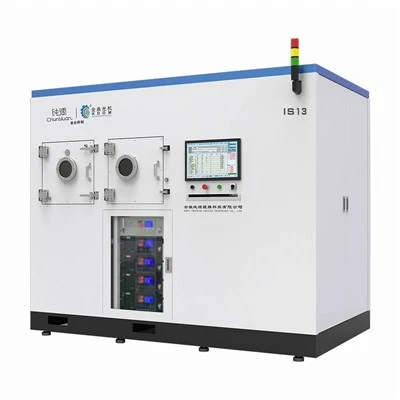
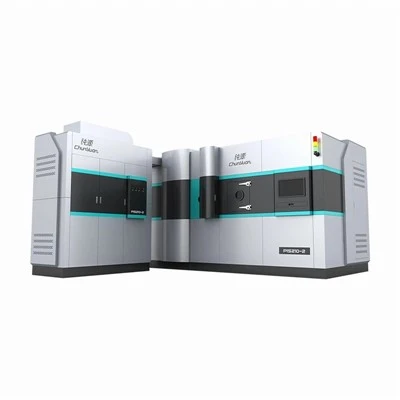
Physical vapor deposition (PVD) system utilizing localized low-voltage, high-current electrical arcs to vaporize solid cathode targets into fully ionized plasma. The high ionization rate (40%-80%) drives dense atomic-level bonding and high compressive stress, enabling high-rate deposition of wear-resistant and decorative coatings on high-speed steel (HSS), carbide cutting tools, automotive components, and medical devices.
Technical Specifications
|
Parameter |
Specification Range / Details |
|
Chamber Dimensions |
Customized internal volume (Φ 800 × 1000 mm to Φ 1500 × 1600 mm, SUS304/SUS316L double-wall water-cooled) |
|
Ultimate Pressure |
≤ 5.0 × 10⁻⁴ Pa (turbomolecular and roots/rotary backing pump configuration) |
|
Working Pressure |
0.1 Pa ~ 2.0 Pa (Ar, N₂, C₂H₂, O₂) |
|
Cathode Arc Sources |
4 to 12 distributed circular/rectangular filtered or standard sources with independent magnetic steering |
|
Substrate Bias |
Pulsed DC bias (0 to -1000 V adjustable, 10–100 kHz) |
|
Heating System |
Radiative quartz heaters; maximum baking temperature 500°C (±5°C uniformity) |
|
Control Architecture |
Siemens PLC + Industrial PC (IPC); automated recipe execution and manual hardware override |
|
Electrical Supply |
3-phase, 380V/480V, 50Hz/60Hz (configured per regional standards) |
Key Features
High Ionization Efficiency: Plasma ionization rate reaches 40%-80%, ensuring superior film-to-substrate adhesion.
Modular Cathodes: Quick-change target assembly minimizes maintenance downtime; compatible with planar and rotatable cylindrical cathodes.
Closed-Loop Gas Control: MKS mass flow controllers maintain precise reactive gas partial pressures for compound films (TiAlN, TiCN).
Multi-Axis Planetary Rotation: Customized rotation and revolution drives ensure thickness uniformity (±5%) across complex 3D geometries.
Dual-Mode Operation: Supports DC arc evaporation and pulsed bias sputtering integration for multi-layer architectures.
Vacuum System Configuration
Roughing Pumps: Roots and rotary vane pump combination for rapid pump-down from atmosphere to 10 Pa.
High Vacuum Pump: Magnetically levitated turbomolecular pump (1600–3200 L/s) ensuring hydrocarbon-free base pressure.
Valves & Gauging: Pneumatic high-vacuum gate valves with Pirani and cold cathode ionization interlocks to prevent oil backstreaming.
[Visual Guide for Web Producer]: Insert schematic or clear photo of the vacuum plumbing layout, highlighting turbomolecular pump and pneumatic gate valve positioning.
Evaporation Materials & Substrate Compatibility
Standard Cathode Targets (Purity ≥ 99.95%)
Transition Metals: Ti, Cr, Zr, Al, TiAl (50/50, 33/67 atomic ratios), CrAl, W, Nb, Si.
Alloys & Compounds: Graphite (for DLC interlayers), stainless steel.
Substrate Compatibility & Pre-Treatment
Materials: WC-Co cutting tools, hobbing cutters, broaches, stamping dies, injection molds, titanium alloys (Grade 5), and stainless steel.
Pre-Treatment: Ultrasonic solvent degreasing and in-situ ion bombardment cleaning (Ar⁺ plasma etching) inside the chamber prior to deposition.
Applications
Cutting & Forming Tools: TiN, TiAlN, and AlCrN coatings raising surface hardness to 3000–3500 HV, suppressing thermal cratering and abrasive wear.
Automotive Components: Friction-reducing coatings for piston rings, fuel injection pins, and gear components.
Medical Implants: Biocompatible TiN and ZrN hard coatings on orthopedic joint replacements and surgical screws.
Decorative Hardware: Color spectrum production (gold brass, rose gold, gunmetal black, titanium grey) via reactive gas tuning.
Customization Options
Chamber Geometry: Vertical loading (pit-mounted or floor-standing) or horizontal front-loading configurations.
Source Configuration: Filtered cathodic arc (FAC) magnetic duct sources to eliminate macroparticles for optical or precision electronics.
Automation: Robotic loading arms, AGV docking integration, and MES data logging protocols.
Quality Control & Factory Testing
Leak Detection: Helium mass spectrometer testing on all chambers and weld seams (≤ 1 × 10⁻⁹ Pa·m³/s).
Electrical Safety: High-voltage insulation resistance, grounding continuity, and PLC interlock functional verification.
Trial Run (FAT): 72-hour continuous dry-run test plus standard coating deposition test evaluated via Calo-test (thickness) and scratch tester (adhesion).
Documentation Package: Electrical schematics, P&ID diagrams, PLC source codes, material certificates, and FAT reports.
Installation & Technical Support
Site Preparation: Detailed layout drawings, cooling water metrics, and power distribution specifications provided 4 weeks prior to shipment.
Commissioning: On-site mechanical assembly, vacuum calibration, and recipe handover by senior process engineers.
Training: Hands-on instruction covering hardware maintenance, vacuum troubleshooting, and safety protocols.
Support: Remote diagnostic software integration for real-time PLC troubleshooting, backed by regional spare parts inventory.
FAQ
Q: How does the system control macroparticles (droplets)?
A: Standard systems use optimized magnetic confinement fields to steer arc spots rapidly. For optical or ultra-smooth applications, we integrate Filtered Cathodic Arc (FAC) magnetic ducts to filter out droplets entirely.
Q: What is the target utilization rate and replacement time?
A: Planar and circular targets achieve 45%-60% utilization. Targets are water-cooled and mounted via quick-clamp seals, allowing target replacement within 45 minutes.
Q: What are the facility utility requirements?
A: Chilled water supply (8–15 m³/h, 18–22°C, 0.2–0.3 MPa), compressed air (0.6 MPa), and stable 3-phase industrial power.
Q: Can existing process recipes be transferred?
A: Yes. The Siemens IPC platform allows direct parameter input for arc current, bias voltage, gas flow, and duration to match existing industrial recipes.
Hot Tags: cathodic arc thin film equipment, China cathodic arc thin film equipment manufacturers, suppliers, factory