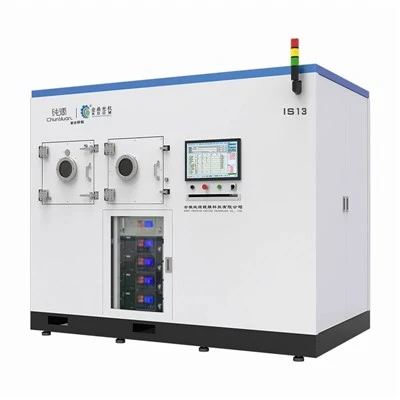
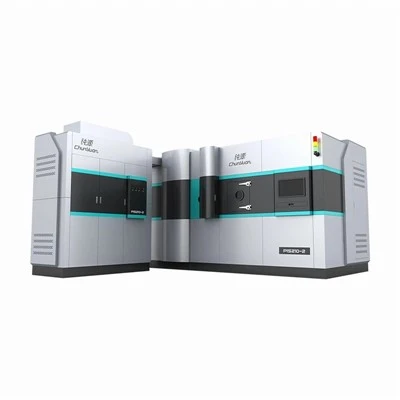
The Industrial Vacuum Arc Thin Film System utilizes cathodic arc evaporation to deposit dense, highly adherent metallic, alloy, and ceramic thin films. A high-current, low-voltage arc vaporizes solid cathode materials into a highly ionized plasma stream (40% - 80% ionization rate), ensuring exceptional film-to-substrate bonding strength and high deposition rates.
Engineered for industrial production and advanced materials research, the platform integrates multi-cathode configurations, precision reactive gas management, and automated process control for industrial coatings such as TiN, TiAlN, CrN, and DLC.
Technical Specifications
|
Parameter |
Specification |
|
Chamber Dimensions |
Phi 600 mm x 600 mm (Customizable up to Phi 1500 mm) |
|
Chamber Structure |
304 Stainless Steel, double-wall water-cooled, internal electropolish Ra <= 0.4 um |
|
Base Pressure |
<= 5.0 x 10^-4 Pa (ISO 3567 compliant) |
|
Working Pressure |
0.1 Pa - 5.0 Pa |
|
Pumping Package |
Rotary vane + Roots blower + High-speed diffusion/turbomolecular pump |
|
Arc Power Supply |
DC/Pulsed DC generators (10 A - 200 A, ripple <= 1%) |
|
Substrate Bias |
Pulsed DC Bias: 0 ~ -1000 V adjustable with arc suppression |
|
Cathode Sources |
2 ~ 6 magnetic-filtered or steering arc sources (Phi 85 / Phi 100 mm) |
|
Substrate Fixture |
Planetary rotation (1 ~ 10 RPM) with heating up to 600 C |
|
Control Architecture |
PLC + Industrial Touch Screen PC (Recipe automation, CFR 21 Part 11 ready option) |
Key Features
High Plasma Ionization: Cathodic arc ionization (40% - 80%) promotes dense film nucleation, eliminating columnar microstructure defects.
Enhanced Adhesion Strength: In-situ high-energy ion cleaning achieves critical scratch loads (Lc) exceeding 40 N on tool steel (ASTM C1624 verified).
Toroidal Magnetic Filtration (Optional): Deflects plasma trajectories to trap and eliminate macro-droplets, producing defect-free smooth nano-coatings.
Closed-Loop Reactive Control: Mass flow controllers (MFCs) precisely regulate N2, O2, C2H2, and Ar for stoichiometric compound deposition.
Rapid Maintenance: Quick-release cathode assembly allows target replacement within 30 minutes.
Vacuum System Configuration
Roughing & Roots Stage: Direct-drive rotary vane and mechanical booster pump for rapid drawdown to 10 Pa.
High Vacuum Stage: Oil diffusion pump with liquid nitrogen cold trap or magnetically levitated turbomolecular pump (1600 L/s) reaching < 5 x 10^-4 Pa.
Gauges & Interlocks: Dual Pirani and Cold Cathode ionization gauges paired with automated pneumatic gate valves and PLC interlocks.
Evaporation Materials & Substrate Compatibility
Cathode Targets (Purity >= 99.95%):
Metals: Ti, Cr, Al, Zr, Cu, Mo, W, Ag, Au
Alloys/Compounds: TiAl, TiSi, CrAl, WC, Graphite (C)
Substrate Materials:
Tool Steels: SKH51, M2, D2, carbide inserts
Alloys: 304/316L Stainless Steel, Inconel, Ti-6Al-4V
Ceramics/Glass: Alumina, quartz (surface activation required)
Applications
Cutting & Forming Tools: TiN, TiAlN, and AlCrN coatings on drills, end mills, and stamping dies (Hardness: 2500 - 3200 HV).
Automotive Components: Low-friction, wear-resistant coatings on piston rings and fuel injection pins.
Decorative Hardware: Functional metallic finishes (gold, rose gold, gunmetal black) for consumer hardware.
Biomedical Implants: Biocompatible hard coatings on surgical and dental devices (ISO 10993 compatible profiles).
Customization Options
Chamber Scale: Enlarged rectangular or cylindrical chambers for high-volume batches.
Hybrid Configurations: Dual-technology integration pairing cathodic arc sources with unbalanced magnetron sputtering (UBMS).
Bias Modes: RF bias integration for insulating or semiconductor substrates.
Data Integration: OPC UA / Modbus TCP protocols for MES connectivity.
Quality Control & Testing
Executed under ISO 9001 Quality Management Standards:
Helium Leak Detection: Mass spectrometer testing on all welds (System leak rate <= 1.0 x 10^-9 Pa*m^3/s, ISO 3529 compliant).
Electrical Safety: Insulation resistance and grounding continuity audited per CE / IEC 60204-1.
Functional Validation: 72-hour continuous mechanical and electrical dry run.
Factory Acceptance Testing (FAT): Trial deposition verifying thickness uniformity (+/- 5%) and adhesion metrics on client test coupons.
Installation & Technical Support
Facility Pre-Check: Complete utility blueprint detailing cooling water (>= 5 m^3/h), power capacity, and exhaust venting.
On-Site Commissioning: Supervised mechanical placement, utility hookup, and vacuum qualification by field engineers.
Operator Training: 5-day hands-on program covering routine operation, maintenance, target replacement, and PLC programming.
Lifecycle Service: Secure VPN remote diagnostics and 48-hour critical spare parts dispatch.
Frequently Asked Questions
Q: How does magnetic filtration affect deposition rate?
A: While magnetic filters completely eliminate macro-droplets for precision optical/electronic surfaces, the plasma steering path reduces the effective deposition rate by approximately 20% - 30% compared to direct non-filtered steering arc configurations.
Q: What is the typical target replacement interval?
A: A standard Phi 100 mm titanium target operated at 100 A yields 60 - 100 production batches, contingent on film thickness and duty cycle.
Q: Are non-conductive substrates compatible with this system?
A: Yes, provided a pulsed DC or RF bias configuration is specified to prevent surface charge accumulation and arcing during ion bombardment.
Q: What are the exact facility utility parameters for the standard unit?
A: Power Supply: 3-phase, 380 V +/- 10%, 50/60 Hz (~45 kW total).
Cooling Water: >= 5 m^3/h at 0.2 - 0.3 MPa (15 C - 25 C).
Compressed Air: 0.5 - 0.7 MPa for pneumatic actuation.
Hot Tags: vacuum arc thin film system, China vacuum arc thin film system manufacturers, suppliers, factory, Metal Nitride Ion Plating Equipment, thin film equipment for 5g technology, thin film equipment for smart manufacturing, thin film metallization system, thin film production line, thin film roll to roll equipment