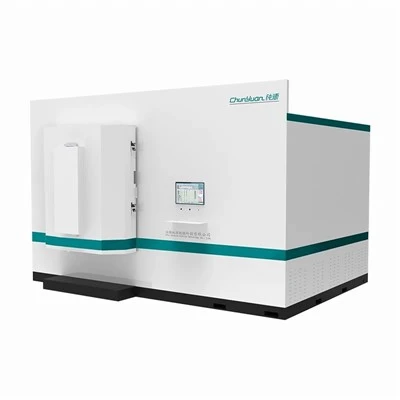
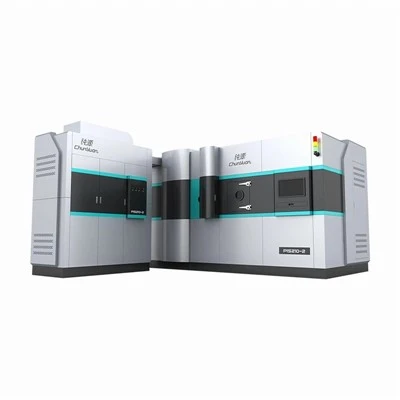
The PVD Hybrid Thin Film Deposition System integrates thermal evaporation, electron beam (e-beam) evaporation, and RF/DC magnetron sputtering within a single vacuum architecture. This platform enables sequential or co-deposition of metals, alloys, and dielectrics without breaking vacuum, preventing interfacial oxidation. Engineered for R&D institutions and pilot production lines, the system handles substrates up to 6 inches with automated multi-axis rotation.
Technical Specifications
|
Parameter |
Specification |
|
Ultimate Base Pressure |
< 5.0 x 10^-6 Pa (baked out) |
|
Pump-down Time |
< 15 minutes to 1.0 x 10^-3 Pa |
|
Substrate Size |
Up to 6-inch diameter wafer / custom holders |
|
Film Thickness Uniformity |
<= +/- 1% across a 4-inch substrate (planetary rotation) |
|
Deposition Sources |
Up to 3 e-beam pockets, 2 thermal boats, 4 magnetron cathodes |
|
Substrate Temperature |
Ambient to 800 deg C (PID controlled) |
|
Chamber Material |
304L / 316L electropolished stainless steel |
|
Safety Compliance |
CE compliant; components built to UL / NFPA standards upon request |
Key Features
Modular Sockets: Interchangeable source flanges allow rapid reconfiguration between sputtering cathodes and thermal/e-beam evaporators.
Isolation Architecture: Pneumatic gate valves isolate the process chamber from the high-vacuum stack to minimize particle generation.
In-Situ Monitoring: Dedicated ports for quartz crystal microbalance (QCM) sensors and optical emission spectroscopy (OES).
Interlocked Safety PLC: Hardware interlocks prevent source activation during high pressure, cooling water failure, or safety breaches.
Vacuum System Configuration
Roughing Pump: Dry scroll pump (30 m^3/h) to eliminate hydrocarbon backstreaming.
High Vacuum Pump: Magnetically levitated turbomolecular pump (1200 L/s for N2) backed by a cryogenic trap.
Gauges: Combined Pirani and Cold Cathode sensors spanning atmosphere to 10^-7 Pa.
Bakeout: Cartridge heater jackets with external insulation blankets reaching up to 150 deg C.
Materials & Substrate Compatibility
Evaporation Materials:
Metals: Au, Ag, Al, Ti, Cr, Pt, Cu, Ni
Dielectrics & Oxides: SiO2, TiO2, Al2O3, ITO
Semiconductors: Si, Ge
Substrate Types: Single-crystal silicon wafers, glass, quartz, polyimide films, and metal foils.
Applications
Optoelectronic Devices: Transparent conductive electrodes (ITO) and multi-layer reflectors for OLEDs and solar cells.
Microelectronic Packaging: Under-bump metallization (UBM) and seed layers for wafer-level packaging.
Advanced R&D: Quantum device structures, superconductor thin films, and magnetic tunnel junctions (MTJ).
Customization Options
Chamber Scale: Extended dimensions for 12-inch substrates or glovebox integration.
Source Setup: Custom crucible volumes, RF bias power supplies, and ion-assisted deposition (IAD) modules.
Automation: Touchscreen recipe management or full SECS/GEM factory automation compliance.
Quality Control
Leak Testing: Helium mass spectrometer testing per chamber (< 1 x 10^-10 Pa*m^3/s threshold).
Dimensional Checks: CMM verification of source-to-substrate distances and flange tolerances.
Electrical Testing: Hi-Pot testing, grounding continuity checks, and EHS audits on all high-voltage lines.
Installation & Support
Factory Acceptance Testing (FAT): Pre-shipment checks for base pressure, source functionality, and automated cycling at our facility.
Field Installation: On-site mechanical alignment, utility hookup verification, and Site Acceptance Testing (SAT).
Documentation: Complete delivery includes electrical schematics, P&ID diagrams, PLC backups, and mill test certificates.
FAQ
Q: Can the system switch between reactive sputtering and thermal evaporation in a single run?
A: Yes. Pneumatic shutters isolate each source, allowing sequential execution without vacuum interruption.
Q: What are the facility utility requirements?
A: Requires 3-phase 380V/480V power, cooling water (18 deg C to 22 deg C at 0.3 MPa), compressed air (0.5 to 0.7 MPa), and a roughing pump exhaust line.
Q: How is cross-contamination prevented between metallic sources?
A: Individual source chimneys, directional baffles, and physical shutters minimize material cross-talk during multi-source runs.
Hot Tags: pvd hybrid thin film deposition system, China pvd hybrid thin film deposition system manufacturers, suppliers, factory