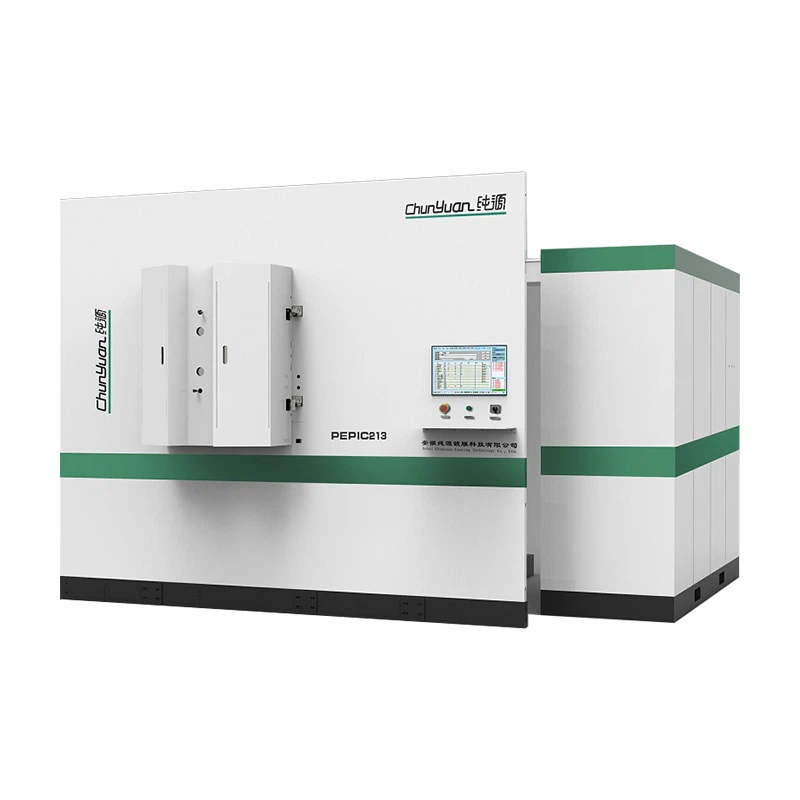
The Electron Beam Thin Film Deposition System delivers directional, high-purity PVD processing for advanced research and industrial production. Utilizing a focused, magnetically steered electron beam directed onto source material inside a water-cooled copper crucible, the system achieves thermal evaporation of refractory metals, oxides, and dielectric compounds without crucible contamination.
Engineered for cleanroom integration, the architecture combines modular vacuum chambers, multi-pocket E-beam guns, and closed-loop process automation to govern film thickness, stoichiometry, and interfacial sharpness.
Technical Specifications
|
Parameter |
Specification Range / Detail |
|
Ultimate Base Pressure |
< 5 x 10^-7 Torr (Cryogenic or turbomolecular configurations) |
|
Pump-Down Time |
< 15 minutes to 1 x 10^-5 Torr (Clean, dry, empty chamber) |
|
E-Beam Gun Power |
3 kW to 10 kW (Multi-pocket sweep controller with auto-sweep) |
|
Crucible Configuration |
4 to 6 pockets; 7 cc to 40 cc capacity per pocket |
|
Substrate Holder |
Rotation-enabled, water/heater-controlled stages supporting up to 200 mm wafers or custom flat substrates |
|
Film Thickness Uniformity |
< +/- 1% across a 100 mm deposition area (Optimized via planetary fixture or source-to-substrate distance) |
|
Deposition Rate Control |
0.01 nm/s to 10 nm/s regulated via dual-channel Quartz Crystal Microbalance (QCM) |
|
Chamber Material |
304L stainless steel, electropolished (Ra < 0.25 um), high-vacuum internal weldments |
Key Features
270-Degree Magnetic Deflection: Bends the electron trajectory to shield the emitter filament from direct vapor flux, extending operational lifespan and stabilizing emission current.
Digital Sweep Control: Programmable beam patterns eliminate localized crucible tunneling and maintain uniform material consumption across multi-pocket hearths.
Closed-Loop QCM Regulation: Dual-sensor feedback dynamically adjusts power supply outputs to stabilize deposition rates and suppress alloy stoichiometry drift.
PLC Interlock Architecture: Real-time monitoring of cooling water flow, high-voltage isolation, door seals, and foreline pressure to protect operators and vacuum integrity.
Auxiliary Deposition Ports: Flanged access points support secondary integration, including thermal boats, ion-assisted deposition (IAD) gridded ion guns, and magnetron sputtering cathodes.
Vacuum System Configuration
Roughing Stage: Oil-free scroll pump paired with a roots blower achieves vibration-isolated roughing down to 10^-2 Torr, eliminating hydrocarbon backstreaming.
High-Vacuum Stage: Turbomolecular pump (1200 L/s to 2200 L/s) backed by a cryogenic trap, sustaining operational process pressures between 10^-6 and 10^-4 Torr.
Chamber Construction: Double-O-ring sealed, stress-relieved 304L stainless steel with electropolished interior surfaces to minimize outgassing and moisture retention.
Film Materials & Substrates
Compatible Deposition Materials
Refractory Metals: Titanium (Ti), Chromium (Cr), Tantalum (Ta), Molybdenum (Mo), Tungsten (W), Platinum (Pt), Gold (Au).
Dielectrics & Oxides: Silicon Dioxide (SiO2), Titanium Dioxide (TiO2), Tantalum Pentoxide (Ta2O5), Aluminum Oxide (Al2O3), Hafnium Dioxide (HfO2).
Compatible Substrates
Semiconductor wafers (Si, GaAs, InP, 2-inch to 8-inch).
Optical glass blanks, quartz, fused silica, and sapphire windows.
Flexible metal foils and ceramic substrates (Al2O3).
Applications
Semiconductor Fabrication: Metal gate contact deposition, barrier layers, and lift-off metallization stacks for microelectronic research and pilot lines.
Precision Optics: Multi-layer optical interference filters, anti-reflective (AR) coatings, high-reflection laser mirrors, and beamsplitters.
Optoelectronics: Transparent conductive electrodes and thin-film layers for OLED displays, photodetectors, and solar cells.
Advanced Materials: Magnetic alloy growth, superconductor precursors, and wear-resistant protective coatings.
Customization Options
Chamber Dimensions: Scaled vertical or horizontal volumes to fit non-standard industrial fixtures or large-area panels.
Co-Evaporation Setups: Integration of multiple E-beam guns and thermal effusion cells for complex alloy synthesis.
Load-Lock Integration: Manual or automated linear transfer arms to maintain high-vacuum integrity during high-throughput wafer loading.
Software Integration: SCADA custom protocols supporting recipe editing, audit logging, and SECS/GEM factory automation standards.
Quality Control
Helium Leak Detection: Mass spectrometer testing ensures chamber weldment leak rates remain below 1 x 10^-9 atm*cm3/sec.
Electrical Verification: High-voltage insulation testing, ground continuity checks, and interlock response validation per industrial safety codes.
Factory Acceptance Testing (FAT): 72-hour continuous operational burn-in recording ultimate vacuum curves, gun emission stability, and automated recipe execution prior to shipment.
Installation & Technical Support
Pre-Installation Guide: Detailed documentation covering closed-loop chilled water loops, exhaust ventilation, electrical load requirements (380V/480V 3-phase), and cleanroom floor loading.
Field Commissioning: On-site mechanical positioning, vacuum line tie-ins, electrical hookups, and baseline calibration executed by factory service engineers.
Operational Training: Hands-on instruction covering filament replacement, crucible reloading, QCM calibration, and routine PLC troubleshooting.
FAQ
Q: What is the standard pump-down time from atmosphere to operating pressure?
A: With a clean, dry chamber and standard turbomolecular setup, the system reaches an operational base pressure of 5 x 10^-6 Torr in under 15 minutes.
Q: Can the system be configured for co-deposition?
A: Yes. Multi-gun configurations or combined E-beam and thermal source setups allow simultaneous co-evaporation with independent rate controllers.
Q: What facility utilities are required?
A: Required utilities include closed-loop chilled water (~20 deg C, 0.3 MPa), compressed air (0.6 MPa) for pneumatic valves, N2 purge lines, and dedicated 3-phase electrical power matching the chosen power supply (3 kW to 10 kW).
Q: How is cross-contamination prevented between different source materials?
A: The multi-pocket hearth utilizes a water-cooled copper assembly with indexable pocket rotation, physically and thermally isolating materials, supplemented by custom shielding to stop cross-flux.
Hot Tags: electron beam thin film deposition system, China electron beam thin film deposition system manufacturers, suppliers, factory