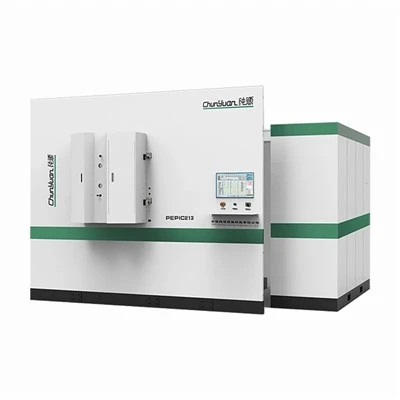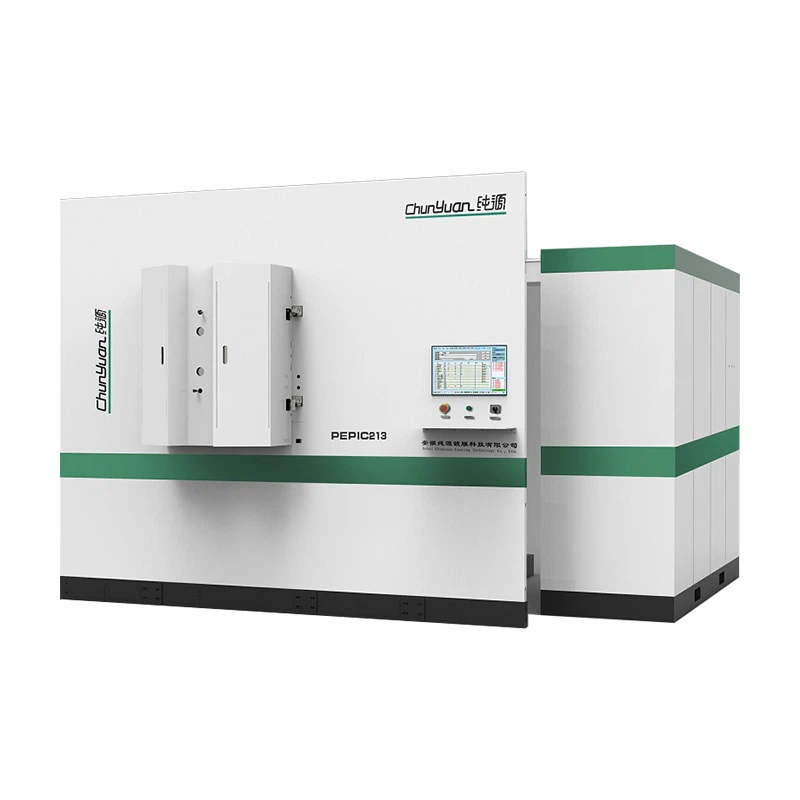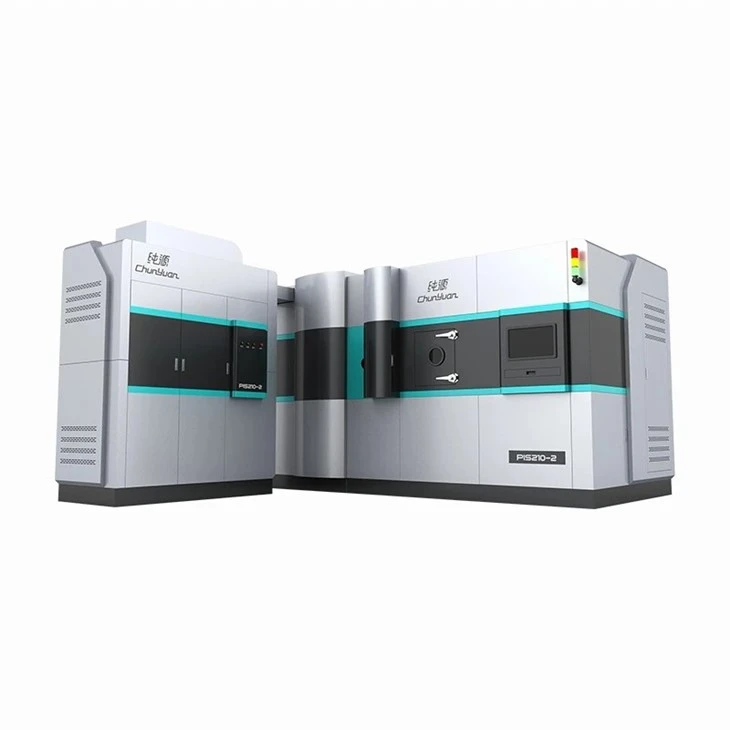
The Multi-Arc Ion Deposition System performs industrial-scale cathodic arc evaporation for hard, wear-resistant, and low-friction thin films. The process achieves >80% ionization of solid cathode material, driving high-energy ion bombardment into the substrate interface for superior film adhesion compared to magnetron sputtering.
The double-walled stainless-steel vacuum chamber houses modular arc sources and a PLC-controlled automated cycle managing pump-down, in-situ plasma etching, reactive gas delivery, and multi-layer deposition.
Technical Specifications
|
Parameter |
Specification |
|
Chamber Size |
Customized inner diameter (Phi 800 mm - Phi 1500 mm) |
|
Vessel Material |
Double-walled SUS304 / SUS316L with internal cooling channels |
|
Base Pressure |
<= 5.0 x 10^-3 Pa (dry-pumped) |
|
Pump-Down Time |
Atmosphere to 6.0 x 10^-2 Pa in <= 15 minutes (clean, empty) |
|
Arc Cathodes |
4 to 12 rectangular or circular sources |
|
Power Supplies |
DC arc (0-200 A) and Pulsed Bias (0-3000 V) |
|
Substrate Rotation |
Multi-axis planetary/single-rotation via magnetic fluid feedthrough |
|
Control System |
Siemens S7-1500 PLC + IPC with automated recipes |
|
Utility Requirements |
Chilling water (18-25 C, 0.2-0.4 MPa); Compressed air (0.5-0.7 MPa) |
Key Features
High Ionization Rate: Minimizes film delamination via dense ion bombardment.
Controlled Arc Stability: Programmable triggers and closed-loop current regulation suppress macroparticle (droplet) formation and prevent target poisoning under reactive gases (N2, C2H2, O2).
Modular Arc Sources: Side and door placements adapt to complex 3D tool geometries for uniform thickness distribution.
Pulsed Substrate Bias: Synchronized voltage pulses tailor residual stress, grain refinement, and microhardness.
Heavy-Duty Rotation Stages: Planetary fixtures support batch loads up to 500 kg under high thermal and vacuum loads.
Vacuum System Configuration
Roughing & Roots: Multi-stage dry screw pumps paired with Roots blowers prevent hydrocarbon contamination down to transition pressures.
High Vacuum: Turbomolecular or diffusion pumps sustain ultra-high base pressure.
Trapping & Gauging: Optional liquid nitrogen cold traps; wide-range Pirani/Cold Cathode combination gauges.
Evaporation Materials & Substrate Compatibility
Cathode Targets: Pure metals (Ti, Cr, Al, Zr, Mo, W) and alloy targets (TiAl, TiSi, CrAl, WC-Co).
Substrate Materials: High-speed steel (HSS), carbide inserts, cold/hot work tool steels (SKD11, H13), stainless steel, and titanium alloys.
Pre-Treatment: Aqueous ultrasonic cleaning followed by in-situ Ar+ or metal ion bombardment etching to remove native oxides.
Applications
Cutting Tools: TiN, TiAlN, and AlCrN coatings on end mills and drills to achieve >3000 HV surface hardness and oxidation resistance.
Molds & Dies: Protective layers on injection molds and stamping dies to prevent galling and abrasive wear.
Automotive: DLC and CrN coatings on piston rings, gears, and injector pins to lower friction coefficients.
Medical Devices: Biocompatible TiN/TiCN coatings on surgical instruments and implants.
Customization Options
Chamber Dimensions & Port Layout: Tailored volume and optical emission monitoring (OEM) ports.
Generators: Customer-specified power supply brands or specialized pulsed-bias configurations.
Filtration: Magnetic steering fields and macroparticle filters for zero-droplet optical/electronic finishes.
Automation: SCADA integration and SQL database connectivity for Industry 4.0 data logging.
Quality Control & Factory Acceptance Testing
Leak Testing: Helium mass spectrometer testing on all welds (<= 1.0 x 10^-9 Pa*m3/s).
Electrical Safety: Insulation resistance, grounding, and interlock verification per CE/NFPA standards.
Functional Dry Run: 72-hour continuous mechanical and valve cycling test.
Process Verification: Reference coupon testing for nanoindentation hardness and scratch adhesion.
Installation & Support
Pre-Installation: Utility layout blueprints provided for power, water, exhaust, and compressed air.
Commissioning: On-site setup and trial runs supervised by factory engineers.
Training: Hands-on operation, cathode replacement, and routine maintenance coaching.
Lifecycle Care: Secure VPN remote diagnostics and local spare parts provisioning.
FAQ
Q: How are macroparticles (droplets) controlled during cathodic arc deposition?
A: Mitigation relies on optimized arc currents, high-speed magnetic steering, and optional magnetic macroparticle filters for ultra-smooth surface requirements.
Q: What is the typical cathode target utilization rate?
A: Utilization ranges between 55% and 70% based on cathode erosion profiles and magnetic field configurations.
Q: Can the system manage reactive gas deposition for multi-element films like TiAlN?
A: Yes. Mass flow controllers (MFCs) use optical emission or partial pressure feedback to stabilize reactive flows (N2, CH4) and maintain stoichiometric composition.
Q: What are the electrical power requirements?
A: Standard systems require 3-phase power (380V-480V, 50/60 Hz), with total load capacities spanning 60 kVA to 150 kVA depending on cathode quantity.
Hot Tags: multi-arc ion deposition system, China multi-arc ion deposition system manufacturers, suppliers, factory