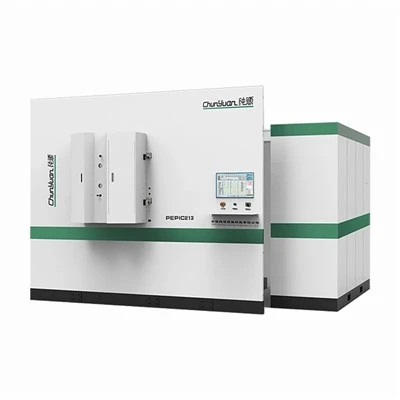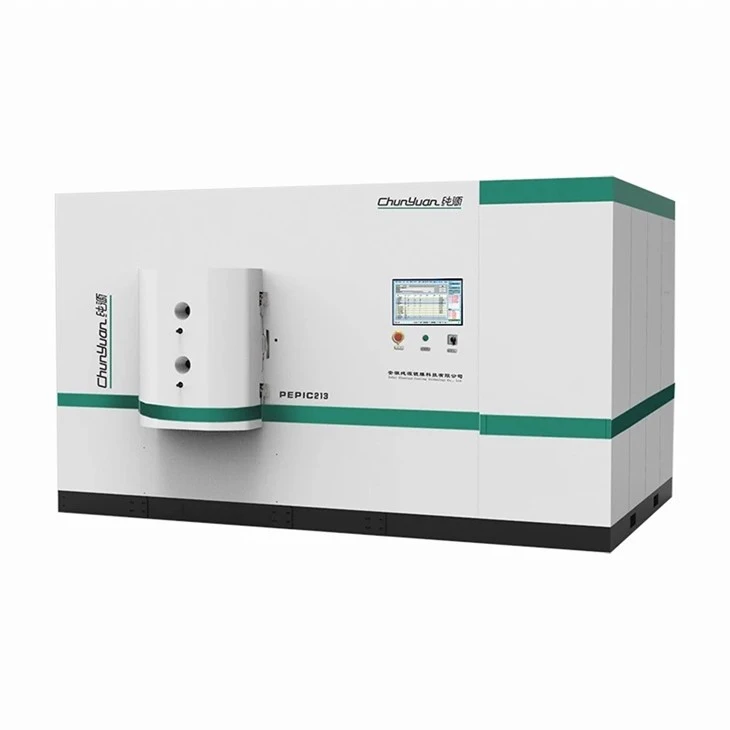
The Industrial Multi-Arc Ion Deposition System generates dense, high-adhesion thin films through high-current, low-voltage cathodic arc evaporation. Solid target materials (cathodes) are vaporized in a reactive gas atmosphere (such as N2, O2, or C2H2) to synthesize stoichiometric compound coatings. Engineered for high ionization rates exceeding 80%, this equipment yields exceptional film-to-substrate bonding strength suited for extreme mechanical load environments.
Technical Specifications
|
Parameter |
Specification |
|
Chamber Dimensions |
Custom configurations from Phi 800 x 1000 mm to Phi 1500 x 2200 mm |
|
Chamber Material |
SUS304 / SUS316L Stainless Steel, double-wall water-cooled jacket |
|
Ultimate Vacuum Pressure |
<= 5.0 x 10^-4 Pa |
|
Pump-Down Time |
Atmosphere to 6.0 x 10^-3 Pa in <= 15 minutes (clean, empty chamber) |
|
Arc Power Supply |
DC and pulsed arc power units (0-200A adjustable, ripple <= 1%) |
|
Bias Power Supply |
High-frequency pulsed bias (-1000V to 0V adjustable) |
|
Evaporation Sources |
4 to 18 cathodic arc sources (filterable or standard magnetic steering) |
|
Substrate Rotation |
Planetary multi-axis rotation driven by magnetic fluid feedthrough |
Key Features
Magnetic Filtered Arc Technology: Integrated magnetic coils deflect macro-particles and droplets away from the substrate stream, producing ultra-smooth droplet-free surfaces for precision optics and cutting tools.
Closed-Loop Gas Flow Control: MKS mass flow controllers regulate reactive gas partial pressure within +/- 0.1 sccm stability thresholds during reactive deposition phases.
Substrate Temperature Management: Programmable radiant heater banks combined with backside argon gas cooling maintain substrate thermal budgets between 150C and 600C.
Automated Process Recipes: PLC-based control architecture executing multi-step deposition protocols from ion cleaning, gradient interlayer etching, to terminal functional coating.
Vacuum System Configuration
Roughing Pump: Roots blower and rotary vane mechanical pump combination (Leybold / Edwards baseline).
High Vacuum Pump: High-throughput diffusion pumps or magnetically suspended turbomolecular pumps (>= 3200 L/s).
Valuation & Piping: Pneumatic stainless-steel vacuum gate valves, pneumatic angle valves, and elastomer-sealed KF/ISO flanges leak-tested via helium mass spectrometry (<= 1.0 x 10^-9 Pa*m^3/s).
Pressure Monitoring: Combined Pirani and Cold Cathode ionization gauges providing real-time feedback across atmosphere to ultra-high vacuum ranges.
Evaporation Materials & Substrate Compatibility
Target Materials: Titanium (Ti), Chromium (Cr), Aluminum-Titanium (AlTi), Zirconium (Zr), Copper (Cu), Stainless Steel, and custom alloy targets (purity >= 99.95%).
Substrate Materials:
- Cemented Carbides (WC-Co)
- High-Speed Steels (HSS)
- Alloy Steels (SKD11, 316L, 4140)
- Titanium Alloys (Ti-6Al-4V)
- Engineering Ceramics and Heat-Resistant Superalloys
Applications
Cutting & Forming Tools: Deposition of TiAlN, AlCrN, and TiCN coatings on end mills, inserts, hobs, and stamping dies to increase surface hardness to 3200 HV and resist abrasive wear.
Automotive Components: Hard carbon (DLC) and CrN deposition on piston rings, fuel injection pins, and camshafts to reduce friction coefficients below 0.1 under dry running conditions.
Medical Implants: TiN and ZrN biocompatible diffusion coatings on cobalt-chromium and titanium knee and hip joints, minimizing metal ion leaching and wear debris generation.
Aerospace Hardware: Oxidation-resistant barrier coatings for turbine blades and fastener assemblies operating at elevated thermal thresholds.
Customization
Chamber Geometry: Vertical pit-type, horizontal front-loading, or double-door pass-through configurations tailored to existing shop-floor layouts.
Source Integration: Hybrid configurations merging cathodic arc sources with unbalanced magnetron sputtering (Ums) cathodes within a single chamber.
Jigging & Fixtures: Dedicated planetary or double-rotation tooling fixtures engineered via CAD/FEM simulation for specific component geometries (e.g., long extrusion dies or complex surgical screws).
Quality Control & Manufacturing Compliance
Quality Management Standards: Designed, fabricated, and tested under ISO 9001:2015 quality management and ISO 14001 environmental management systems.
Aerospace & Medical Traceability: Process controls and documentation protocols fully aligned with NADCAP AC7102 (Heat Treating/Surface Enhancement) requirements upon request.
Leak Integrity: Every vacuum vessel undergoes helium mass spectrometer leak testing prior to assembly sign-off.
Electrical Safety: High-voltage insulation resistance testing and grounding continuity checks conforming to CE / IEC standards.
Run-off Testing: 72-hour continuous dry-run endurance testing of mechanical rotation drives, water-cooling flow switches, and PLC interlock systems.
Documentation Deliverables: Material mill test certificates (MTC), vacuum leak test certificates, electrical schematic packages, and NIST-traceable sensor calibration reports.
Installation & Technical Support
Site Preparation Guidelines: Comprehensive utility layout documentation covering cooling water flow rates (>= 30 m^3/h), ambient temperature ranges, exhaust ventilation, and electrical power drops (3-phase, 380V/480V, 50/60Hz).
Commissioning Services: On-site mechanical positioning, vacuum piping integration, electrical hookup, and baseline recipe optimization executed by resident senior field service engineers.
Operator Training: 5-day intensive on-site training addressing routine maintenance, vacuum troubleshooting, target replacement protocols, and parameter tuning for specific film structures.
Spare Parts Inventory: Critical wear components (cathode insulators, dark space shields, dynamic seals, and filament arrays) stocked regionally for dispatch within 48 hours.
FAQ
Q: How is film thickness uniformity maintained across complex 3D substrates?
A: Uniformity is achieved via multi-axis planetary rotation fixtures combined with computerized magnetic steering coils that dynamically adjust ion plasma density distribution across the substrate zone, maintaining thickness variation within +/- 5%.
Q: What prevents macro-droplets from forming on the coated surface?
A: Macro-droplet generation is suppressed through filtered cathodic arc (FCA) technology utilizing curved magnetic duct filters that trap solid particulates while allowing ionized vapor to reach the substrate.
Q: What utility infrastructure is required on-site?
A: Facilities require a closed-loop chilled water system (capacity >= 80 kW, inlet temperature 18 to 22C), compressed air supply (0.6 to 0.8 MPa for pneumatic valves), dry nitrogen purging lines, and dedicated electrical power distribution matching system load requirements.
Q: Can this system deposit multilayer or gradient coatings?
A: Yes. The PLC architecture allows sequential activation of multiple target materials and real-time adjustment of reactive gas flows to deposit nano-layered structures or functional gradient interlayers.
Hot Tags: multi-arc ion deposition equipment, China multi-arc ion deposition equipment manufacturers, suppliers, factory